Livres
Référence : 59959"HART, BERNARD & C. SPEARMAN.
General Ability, its Existence and Nature. (Original off-print) From The Journal pf Psychology, Vol. V. Part 1, March 1912. - [PIONEERING FACTOR ANALYSIS - PRESENTATION-COPY]Cambridge, (1912). 8vo. Original printed wrappers. A bit of wear to extremities. A few nicks and creases. Inscribed to front free end-paper and with a few ownership-stamps (of the presentee- Dr. Richard Goldschmidt). (2) pp., pp. (51) - 79.
Original off-print of Spearman and Hart's groundbreaking paper on general ability, which created a conceptual framework for factor analysis and played an enormous role in IQ-testing, with an original handwritten and signed presentation-inscription from Spearman to Richard Goldschmidt (fellow psychologist and director of the Institute for Experimental Psychology at the University of Münster), expressing friendly remembrance of the Berlin congress 1912. ""Spearman, with a collaborator, Hart, pioneered the use of the pattern of correlations between a set of measures to determine the number of abilities (Hart & Spearman, 1912). The tetrad difference criterion could test if a single common factor (g, or general ability, presumably) could account for individual differences on the measures. If the tetrad differences were zero, then a single common factor was supported, but if not, then it was unclear how many common factors were needed."" (Susan E. Embretson: The Second Century of Ability Testing: Some Predictions and Speculations, 2001, p. 11) Charles Edward Spearman (1863 - 1945) was a famous English psychologist known both for his work in statistics, but primarily for his work on human intelligence. He was a pioneer of factor analysis, he gave name to the Spearman's rank correlation coefficient and did seminal work on models for human intelligence, including his theory that disparate cognitive test scores reflect a single General intelligence factor, and he famously coined the term ""g- factor"". The g-factor, also known as General intelligence, refers to the existence of a broad mental capacity that influences performance on cognitive ability measures. Terms such as intelligence, IQ, general cognitive ability, and general mental ability are today used interchangeably to mean the same thing as general intelligence or g-factor. ""Charles E. Spearman, in full Charles Edward Spearman, (born September 10, 1863, London, England-died September 17, 1945, London), British psychologist who theorized that a general factor of intelligence, g, is present in varying degrees in different human abilities.While serving as an officer in the British army (1883-97), Spearman came to believe that any significant advance in philosophy would come about mainly through psychology. Over the next 10 years he worked intermittently with Wilhelm Wundt, the founder of experimental psychology, at the University of Leipzig, and he took his Ph.D. there. He joined the faculty of University College, London (1907), and was professor there from 1911 to 1931.Spearman's attempt to establish general, fundamental laws of psychology was based on his statistical work in determining correlations among mental abilities, reflected in his classic paper, "" 'General Intelligence,' Objectively Determined and Measured"" (1904). He sought to interpret correlations among several variables on the basis of a specific factor for each variable and a factor common to all. Because measures of seemingly different mental abilities consistently indicate correlations, he concluded that the prevalence of positive correlations must result from the general factor, g. By 1912 he and a coworker had developed an order of correlation coefficients separating various performances into the general factor, g, and varying specific factors, s1, s2, and so on."" (Encycl. Britt.). The present paper is of the utmost importance, as it is here that Spearman, in collaboration with Hart, develops a conceptual framework for factor analysis, pioneering the use of the pattern of correlations in order to determine the number of abilities, one of the fundamental principles for psychometric methods.

Copenhagen, Danemark
18 000,00 DKK
Livres
Référence : 8218Oléron, Pierre :
Composantes (Les) de l’intelligence d’après les recherches factorielles. Préface par Henri Piéron.Paris, Presses Universitaires de France (Bibliothèque Scientifique Internationale Sciences humaines section psychologie), 1957 ; in-8, broché ; VIII, 517, (3) pp. , couverture verte imprimée.
Exemplaire non coupé, en bon état général, petite traca de mouillure sans importance.
30,00 €
Livres
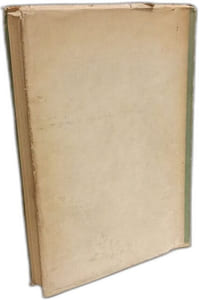
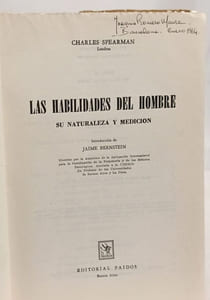
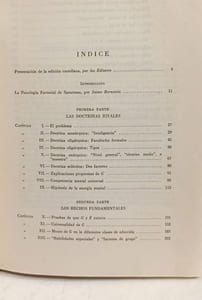
Référence : 100137970Spearman
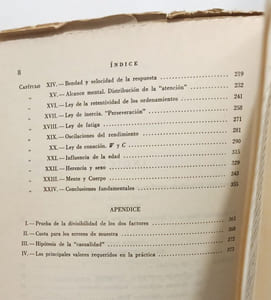
LAS HABILIDADES DEL HOMBRE --- su naturaleza y medicionPaidos 1955 in8. 1955. Broché.
Bon état cependant bords très frottés
24,00 €
Livres
Référence : 70548Spearman
Les Aptitudes de l'Homme leur Nature et leur MesureParis, 1936, in-8, 351pp, broché, Couverture salie sinon très bel exemplaire! 351pp
30,00 €
Livres
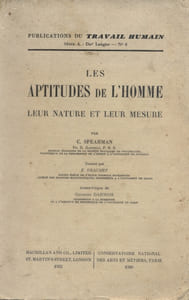
Référence : 79764SPEARMAN C.
Les aptitudes de l'homme. Leur nature et leur mesure.Couverture souple. Broché. 351 pages. Couverture légèrement défraîchie.
Livre. Avant-propos de Georges Damois. Traduit par F. Brachet. Conservatoire National des Arts et Métiers (Collection : Publications du Travail Humain), 1936.

27,00 €
Livres
Référence : 22011SPEARMAN C.
Les Aptitudes De L'homme, Leur Nature et Leur MesureParis et Londres Presses Universitaires De Fra - PUF 1936 In-8 351 pp, publié par le conservatoire national des arts et métiers
Bon Broché à raba

Clohars Fouesnant, France
35,00 €
Livres
Référence : SP308RLWSPEARMAN C.
PERSONNALITE VOLONTAIRE, PERSONNALITE INTELLECTUELLE [Unknown Binding]Broche bon etat .Etat d usage (1939).Interieur tres propre . PERSONNALITE VOLONTAIRE, PERSONNALITE INTELLECTUELLE de Spearman. 1939. 23 pages.
Merci de nous contacter à l'avance si vous souhaitez consulter une référence dans notre boutique à Authon-du-Perche.

Authon-du-perche, France
25,00 €
Catalogue thématique
- Kristeva Julia
- Kübler-Ross Elisabeth
- Ladame François
- Laforgue René
- Laguerre Maxime
- Lambert Max
- Lambotte Marie-Claude
- Le Bon Dr Gustave
- Lebovici Serge
- Lévy-Leboyer Claude
- Lévy Philippe
- Lévy-Valensi
- Loewenstein R.
- Loo Pierre
- M'Uzan Michel de
- Maeder A
- Maisonneuve Jean
- Maldiney Henri
- Mannoni Octave
- Mannoni Pierre
- Marc Edmond
- Matisson Maurice David
- Mauco G
- Maugendre Dominique
- McDougall William
- Mendel Gerard
- Mendousse Pierre
- Mensonge
- Meyerson Ignace
- Michaud Ginette
- Mijolla Alain de
- Miller Gérard
- Milner Marion
- Minkowski Eugène
- Monnier-Raball Jacques
- Morel Corinne
- Moreno J. L.
- Morgan Clifford T
- Moscovici Serge
- Mucchielli Roger
- Murray Henry A
- Nachin Claude
- Nasio Juan David
- Névrose
- Obsession
- Œdipe
- Pavlov Ivan Petrovitch
- Peck Scott
- Pelicier Yves
- Phobie
- Piaget Jean
- Piéron Henri
- Piron Herman
- Psyché
- Psychodrame
- Psychogénèse
- Psychologie individuelle
- Psychométrie
- Psychopathologie
- Psychose
- Psychosomatique
- Psychothérapie
- Rahmy Maryvonne
- Rausch de Traubenberg Nina
- Reich Wilhelm
- Reik Théodor
- Reuchlin Maurice
- Richard Michel
- Richelle Marc
- Robert Marthe
- Robin Gil
- Rorschach Hermann
- Roudinesco A.
- Roudinesco Élisabeth
- Roussiau
- Rubinstein Henri
- Saint Laurent Claude
- Salgues Yves
- Salomon Paule
- Schilder Paul
- Schmidt Véra
- Schultz-Hencke Dr H.
- Segonzac Jacqueline de
- Slater Lauren
- Stafford-Clark David
- Stein Conrad
- Steiner Michel
- Stéphane André
- Subconscient
- Thinès Georges
- Tort Michel
- Trognon Alain
- Vaillant Maryse
- Vauthier Gilles
- Viaud Gaston
- Vinh Bang
- Vivien Claude
- Watzlawick Paul
- Wilson Lynn