Livres
Référence : Zn12ALBERA François
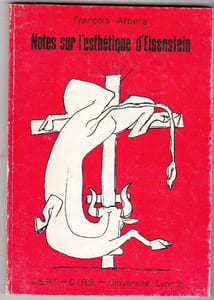
Notes Sur L'esthétique d'EisensteinLyon CerT CIRS université De Lyon2 1973 In8 120 pages - broché - très bon état
Très bon

Vendôme, France
96,00 €
Livres
Référence : QWA-13599ALBERA François - KLEIMAN Naoum (texte établi par)
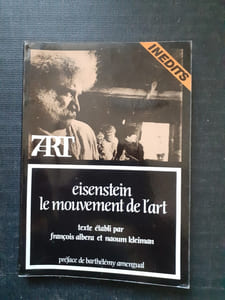
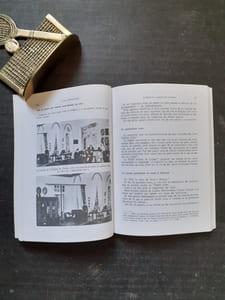
Eisenstein le mouvement de l'artLes Editions du Cerf, 1986, in-8 br., 288 p., coll. "Septième Art", préface de Barthélémy Amengual, nombreux dessins et schémas, très bon état.
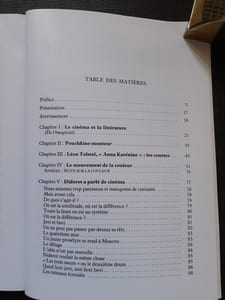
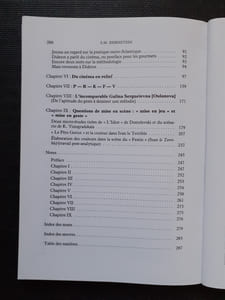
Grand cinéaste, Eisenstein fut aussi le plus grand théoricien du Septième Art. Dans ce volume de textes inédits, il aborde sous un jour neuf la littérature, le théâtre, étudie la musique et la danse et analyse les films de ses contemporains. Voir le sommaire sur photos jointes.
30,00 €
Revues
Référence : 23366Anthologie du Cinéma - Eisenstein (Rostislav Yourenev)
Anthologie du Cinéma : Eisenstein (Traduction et notes de Luda Schnitzer) (Rostislav Yourenev)n° 1 - 1965 - supplément à l'avant scène du cinéma N° 44 - broché - 62 pages
Bon état
Lyon, France
12,00 €
Livres
Référence : 500367060Bernice Eisenstein
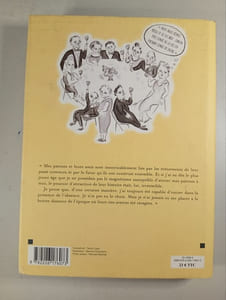
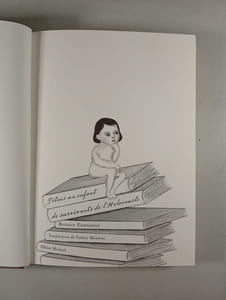
J'étais un enfant de survivants de l'HolocausteAlbin Michel Sans date.
Bon état

15,00 €
Revues
Référence : 25019Cahiers du cinéma - Comité de rédaction : Jacques Doniol-Valcroze, Daniel Filipacchi, Pierre Kast, Jacques Rivette, Roger Thérond, François Truffaut.
Cahiers du cinéma N° 208 : S. M. Eisenstein (Mon dernier entretien avec Eisenstein (Ilya Veissfeld) - Roman Polanski (Entretien avec Roman Polanski, Folie et autres rêves (Jean-Louis Comolli), Filmographie de Polanski) - Satyajit Ray (Pourquoi je fais des films, Renoir à Calcutta, Quelques aspects de mon métier, Satyajit Ray à la cinémathèque) - Jean-Pierre Lefevre / Petit journal du cinéma - le cahier critique1969 N° 208 - Février 1969 - En couverture: Les Rolling Stones dans "one plus one" - Revue mensuelle du cinéma - In-4 Broché - 65 pages - Nombreuses reproductions photographiques en noir et blanc
bon état - infimes frottements sur la couv.
Lyon, France
11,00 €
Revues
Référence : 25018Cahiers du cinéma - Comité de rédaction : Jacques Doniol-Valcroze, Daniel Filipacchi, Pierre Kast, Jacques Rivette, Roger Thérond, François Truffaut.
Cahiers du cinéma N° 209 : S. M. Eisenstein (Pauvre Salieri ! (en guise d'envoi) (S.M. Eisenstein), Perspectives (S.M. Eisenstein)) - Walerian Borowczyk (Entretien avec Walerian Borowczyk, Sylvie Pierre et Jacques Rivette, L'île Borromée, L'évidence même (Patrice Leconte), Liste de films) - Problème du direct...N° 209 - Février 1969 - Revue mensuelle du cinéma - In-4 Broché, couverture illustrée (Raoul Darblay, Ligia Branice et Hubert Lassiat) - 65 pages - Nombreuses reproductions photographiques en noir et blanc
bon état - Infime frottement sur la couv.
Lyon, France
11,00 €
Revues
Référence : 25017Cahiers du cinéma - Comité de rédaction : Jacques Doniol-Valcroze, Daniel Filipacchi, Pierre Kast, Jacques Rivette, Roger Thérond, François Truffaut.
Cahiers du cinéma N° 210 : Montage (Questions théoriques. Le Montage (Jean Narboni, Sylvie Pierre et Jacques Rivette)) - S. M. Eisenstein (Ecrits (2), "Eh !" De la pureté du langage cinématographique) - Fernando Ezequiel Solanas - Hongrie...1969 N° 210 - Mars 1969 - Revue mensuelle du cinéma - In-4 Broché, couverture illustrée ("Ma nuit chez Maude" d'Eric Rohmer) - 65 pages - Nombreuses reproductions photographiques en N&B
bon état - dos très légèrement jauni
Lyon, France
14,00 €
Livres
Référence : lc_81816Charles Eisenstein, Thomas Hardtmuth, Christoph Hueck, Andreas Neider
Covid-19. Guerre Ou Initiation ? - Dans Quel Monde Voulons-Nous VivreTriades (15 octobre 2020)
Livre à l'état de neuf, très frais sans annotations ni défauts dissmulés.

Genève, Suisse
12,00 €
Revues
Référence : 50267Ciné-Club - Organe de la Fédération Française des Ciné-Clubs (S. M. Eisenstein)Président : Jean Painlevé
Ciné-Club S. M. Eisenstein 1898-1948. Sur le style d'Eisenetein (Jean Mitry) / Une force prodigieusement vivante (Alexandre Arnoux) / Permanence d'un style (Léon Barsacq) / S. M. Eisenstein, Le patriotisme est mon thème / Le contre-point "son-image" (Armand Panigel) / Notes au sujet d'Alexandre Nevsky (Henri Fescourt) / L'oeuvre d'Eisenstein (G. Sadoul) / La révélation du Potemkine (Georges Altman) - ...N° 5 - mars 1948 - Redaction, Administration : 2, rue de l'Elysée. Paris-8e - Journal illustré
bon état
Lyon, France
31,00 €
Livres
Référence : 2527Collectif
LA LITTERATURE DE LA REVOLUTION MONDIALEOrgane central de l’Union internationale des écrivains révolutionnaire, Edition d’Etat, Moscou, Leningrad, 1931.
Une revue in-4°(18x25 cm), brochée, couverture souple éditeur, premier plat présenté dans le style des années 30, avec des lettres noires et rouges. Cette revue compte 158 pages , parmi lesquelles quelques illustrations en noir et des reproductions d’images du film d’Eisenstein (Cuirassé Potemkine). Au sommaire.... Pièces, Contes, Documentaires: Bruno JASIENSKI (Le Bal des Mannequins), N. TIKHONOV (Les Nomades), FOUDJIMORI-SEYKITI (L’Homme qui n’applaudissait pas). LUTCHÉ-TSINQ (A la Conférence des Soviets de Chine). Articles: A SELIVANOVSKI (La Littérature Prolétarienne de M. Poulaille), A. STOLIAROV (Le Freudisme et les “Freudo-marxistes”), PLEKHANOV (L’Art et la Vie Sociale), ANISSIMOV (Les films de S.Eisenstein). Chronique Internationale: URSS, Tchécoslovaquie, Hongrie, Lithuanie, Roumanie, Bulgarie, Pologne, Japon, Chine. Cette revue ne connut que 6 numéros dont le premier fit scandale (il marqua même le début de la séparation entre communistes et surréalistes). La cause en fut un poème d’ARAGON qui attira des ennuis judiciaires à ARAGON (lequel était le rédacteur en chef de l’édition française), un poème dont deux vers disaient “ Camarades/ Descendez les flics!”… En tout cas la puissance de notre exemplaire –le numéro 3 de la série- reste d’un haut niveau de combativité et d’analyse même s’il peut paraître inférieur à celui du N° 1. PROCHE DU TRES BON ETAT.
280,00 €
Livres
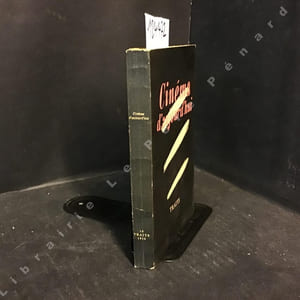
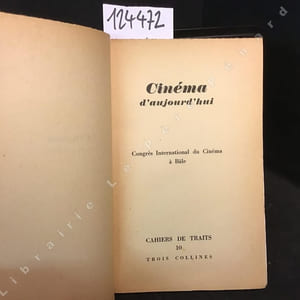
Référence : 124472COLLECTIF - Direction de Jean Descoullayes
Cinéma d'Aujourd'hui1946 Éditions des Trois Collines, Genève, collection "Cahiers de Traits" N° 10 - In-12, broché - 255 pages - Photographies hors texte en N&B
Bon état - Couverture très légèrement frottée Bon

Lyon, France
18,00 €
Livres
Référence : 028387DONIOL-VALCROZE, BAZIN, LO DUCA, ASTRUC, AURIOL, EISENSTEIN, FRANK
CAHIERS DU CINÉMA. Tome II. N° 11 à 20. AVRIL 1952 / FEVRIER 1953 (Fac-similés)Paris Cahiers du Cinéma / éditions de l'étoile 1988 un fort volume grand in-8° (250 x 175mm) réunissant dix numéros, 80 pages par numéro. Reliure toilée de l'éditeur à la Bradel, dos titré, jaquette. Édition fac-similé de cette célèbre revue de cinéma créée en avril 1951 par André Bazin, Jacques Doniol-Valcroze, Joseph-Marie Lo Duca et Léonide Keigel. Avec ses couvertures jaunes illustrées. Texte sur deux colonnes accompagné de nombreuses illustrations en noir & blanc (photogravures). Très bel exemplaire.
Pézenas, France
50,00 €
Livres
Référence : 18091Eisenstein
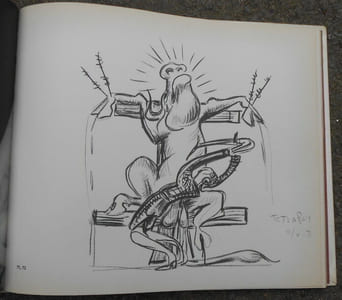
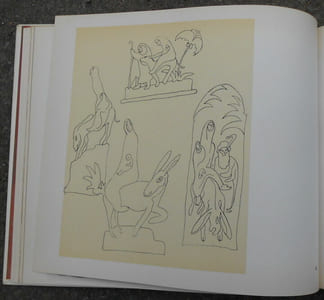
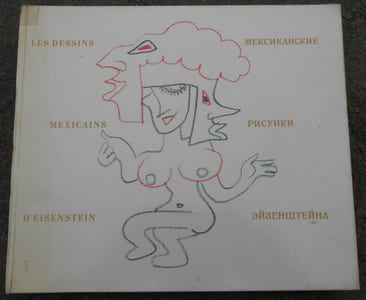
Les Dessins Mexicains d'Eisenstein1969. Moscou Éditions Sovietski Khoudojnik 1969 - Cartonné 24 5 cm x 28 cm 129 pages ills et photos noir & blanc - Texte en français et en russe préface de I. Karetnikova présentation de L. Steinmers choix des dessins de I. Karetnikova et N. Kleiman - Bon état
Rochefort, France
120,00 €
Livres
Référence : 76160[EISENSTEIN].-
Les dessins mexicains d'Eisenstein. Préface de I. Karetnikova.1969 Moscou, Edition Sovietski Khoudojnik, 1969, in 4° à l'italienne, cartonnnage illustré de l'éditeur ; texte bilingue russe et français.
Illustré de 129 gravures hors-texte en noir et en couleurs. Fermeture du 1er au 23 Août
Saint-Etienne, France
80,00 €
Livres
Référence : 33974Eisenstein
Que viva MexicoVision ,1951, in-8 de 90 pages ,illustrations hors-texte ,relié , jaquette illustrée ,Bon état , .(2 photos du livre sur mon site https://www.vieuxlivre.fr) .Les frais de port pour la France sont offerts à partir de 25 euros d'achat (Mondial relay ). (colissimo suivi +6,90 ).
Illiat, France
15,00 €
Livres
Référence : Z36328EISENSTEIN Avi
Avi Eisenstein Echoes [Hardcover] EISENSTEIN Avi, and 5 Continents - Fondazione MudimaRELIE
Merci de nous contacter à l'avance si vous souhaitez consulter une référence dans notre boutique à Authon-du-Perche.

Authon-du-perche, France
36,00 €
Livres
Référence : R300264951EISENSTEIN, Bernice.
J'étais un enfant de survivants de l'Holocauste.Albin Michel. 2006. in-8. Relié. Bon état, Couv. convenable, Dos satisfaisant, Intérieur frais. Paris, Albin Michel, 2006, grand in 8, reliure éditeur sous jaquette, dessins, 186 pp.. Avec Jaquette. . . Classification Dewey : 940.53-Seconde Guerre mondiale 1939-1945
DP-006 - Lieu d'édition : Paris Classification Dewey : 940.53-Seconde Guerre mondiale 1939-1945


Sablons, France
24,90 €
Livres
Référence : SLIVCN-9781583947241Eisenstein, Charles
The More Beautiful World Our Hearts Know Is PossibleNorth Atlantic Books (11/2013)
LIVRE A L’ETAT DE NEUF. EXPEDIE SOUS 3 JOURS OUVRES. NUMERO DE SUIVI COMMUNIQUE AVANT ENVOI, EMBALLAGE RENFORCE. EAN:9781583947241
Genève, Suisse
31,47 €
Livres
Référence : 47093"EISENSTEIN, G.
Über die Irreductibilität und einige andere Eigenschaften der Gleichung, von welcher die Theilung der ganzen Lemniscate abhängt (+) Über eine allgemeine Eigenschaften der Gleichung, von welcher die Theilung der ganzen Lemniscate abhängt, nebst Anwendu... - [Eisenstein's Criterion]Berlin, G. Reimer, 1850. 4to. Bound in later marbled wrappers, as extracted from ""Journal für die reine und angewandte Mathematik, 28 Band, 4. Heft, 1844"". Very fine and clean. Pp. 160-179" Pp. 224-274 Pp. 275-287 [Entire issue: 289-380 + 2 folded plates].
First publication of lemniscate function and Eisenstein's Criterion, one of the best known irreducibility criteria of polynomials. It is often seen referred to as the Schönemann-Eisenstein. Euler had introduced and studied the arc length of the lemniscate in the 18th century, this work laying the ground work for the later development of elliptic functions. The lemniscate function expresses the parameter of the lemnicate in terms of its arc-length. It can be extended to complex values of the parameter, and it then makes sense to ask for the points which divide the lemniscate into m equal parts, where m is a Gaussian integer (a complex number). Abel had shown that the determination of these points reduced to finding the roots of a certain polynomial equation. A crucial point in Eisenstein's extension of Abel's work described in the present papers was to prove that this polynomial is irreducible. Eisenstein developed his eponymous criterion to establish this (although today it is most familiar when applied to the more elementary case of a polynomial with ordinary integer coefficients).

Copenhagen, Danemark
2 500,00 DKK
Livres
Référence : 45141"EISENSTEIN, G. [GOTTHOLD].
Allgemeine Untersuchungen über die Formen dritten Grades mit drei Variabeln, welche der Kreistheilung ihre Entstehung verdanken.Berlin, G. Reimer, 1844. 4to. As extracted from ""Journal für die reine und angewandte Mathematik, 28 Band, 4. Heft, 1844"". Without wrappers and backstrip. Fine and clean. [Eisenstein:] Pp. 289-374. [Entire issue: 289-380 + 2 folded plates].
First printing of German mathematics prodigy Eisenstein's paper on third degree equations with basis in a devided circle. Even though he died prematurely at the age of 29, he managed to prove biquadratic reciprocity, Quartic reciprocity, Cubic reciprocity, to be imprisoned by the Prussian army for revolutionary activities in Berlin and making Gauss state that: ""There have been only three epoch-making mathematicians: Archimedes, Newton, and Eisenstein"". Alexander von Humboldt, then 83, accompanied Eisenstein's remains to the cemetery. The papers presented in the present issue is among his most prominent and made him famous throughout the mathematical world. (James, Driven to innovate, P. 88). ""The twenty-seventh and twenty-eighth volumes of Crelle's Journal, published in 1844, contained twenty-five contributions by Eisenstein. These testimonials to his almost unbelievable, explosively dynamic productivity rocketed him to fame throughout the mathematical world. They dealt primarily with quadratic and cubic forms, the reciprocity theorem for cubic residues, fundamental theorems for quadratic and biquadratic residues, cyclotomy and forms of the third degree, plus some notes on elliptic and Abelian transcendentals. Gauss, to whom he had sent some of his writings, praised them very highly and looked forward with pleasure to an announced visit. In June 1844, carrying a glowing letter of recommendation from Humboldt, Eisenstein went off to see Gauss. He stayed in Göttingen fourteen days. In the course of the visit he won the high respect of the ""prince of mathematicians,"" whom he had revered all his life. The sojourn in Göttingen was important to Eisenstein for another reason: he became friends with Moritz A. Stern-the only lasting friendship he ever made. While the two were in continual correspondence on scientific matters, even Stern proved unable to dispel the melancholy that increasingly held Eisenstein in its grip. Even the sensational recognition that came to him while he was still only a third-semester student failed to brighten Eisenstein's spirits more than fleetingly. In February 1845, at the instance of Ernst E. Kummer, who was acting on a suggestion from Jacobi (possibly inspired by Humboldt), Eisenstein was awarded an honorary doctorate in philosophy by the School of Philosophy of the University of Breslau.Eisenstein soon became the subject of legend, and the early literature about him is full of errors. His treatises were written at a time when only Gauss, Cauchy, and Dirichlet had any conception of what a completely rigorous mathematical proof was. Even a man like Jacobi often admitted that his own work sometimes lacked the necessary rigor and self-evidence of methods and proofs."" (DSB)
Copenhagen, Danemark
1 200,00 DKK
Livres
Référence : 45142"EISENSTEIN, G. [GOTTHOLD].
Beiträge zur Theorie der elliptischen Functionen (+) Notiz über Partialbrüche,Berlin, G. Reimer, 1846. 4to. In ""Journal für die reine und angewandte Mathematik, 33 Band, 1. Heft, 1846"". In the original printed wrappers, without backstrip. Fine and clean. Last leaf with repair. [Eisenstein:] Pp. 59-70"" Pp. 71-88. [Entire issue: IV, 92, (2) + 2 plates.].
First printing of two papers by Eisenstein, one of them (Beiträge zur Theorie...) being the first of his 1846-47-period where he mainly occupied himself with the theory of elliptic functions.Even though the German mathematics prodigy Eisenstein's died prematurely at the age of 29, he managed to prove biquadratic reciprocity, Quartic reciprocity, Cubic reciprocity, to be imprisoned by the Prussian army for revolutionary activities in Berlin and making Gauss state that: ""There have been only three epoch-making mathematicians: Archimedes, Newton, and Eisenstein"". Alexander von Humboldt, then 83, accompanied Eisenstein's remains to the cemetery. The papers presented in the present issue is among his most prominent and made him famous throughout the mathematical world. (James, Driven to innovate, P. 88). The issue also contain papers by famous contemporary mathematicians such as: C. G J. Jacobi, A. Cayley, Dirichlet and J. Steiner.""Eisenstein soon became the subject of legend, and the early literature about him is full of errors. His treatises were written at a time when only Gauss, Cauchy, and Dirichlet had any conception of what a completely rigorous mathematical proof was. Even a man like Jacobi often admitted that his own work sometimes lacked the necessary rigor and self-evidence of methods and proofs."" (DSB)
Copenhagen, Danemark
1 500,00 DKK
Livres
Référence : 45140"EISENSTEIN, G. [GOTTHOLD].
Einfacher Beweis und Verallgemeinerung des Fundamentaltheorems für die biquadratischen Reste (+) Geometrischer Beweis des Fundamentaltheorems für die quadratischen Reste.Berlin, G. Reimer, 1844. 4to. In ""Journal für die reine und angewandte Mathematik, 28 Band, 3. Heft, 1844"". In the original printed wrappers, without backstrip. Last leaf with repair. Fine and clean. [Eisenstein:] Pp. 223-245"" Pp. 246-247. [Entire issue: 193-288, (2), + two folded plates.]
First printing of two important papers by the German mathematics prodigy Eisenstein. Even though he died prematurely at the age of 29, he managed to prove biquadratic reciprocity, Quartic reciprocity, Cubic reciprocity, to be imprisoned by the Prussian army for revolutionary activities in Berlin and making Gauss state that: ""There have been only three epoch-making mathematicians: Archimedes, Newton, and Eisenstein"". Alexander von Humboldt, then 83, accompanied Eisenstein's remains to the cemetery. The papers presented in the present issue is among his most prominent and made him famous throughout the mathematical world. (James, Driven to innovate, P. 88). ""The twenty-seventh and twenty-eighth volumes of Crelle's Journal, published in 1844, contained twenty-five contributions by Eisenstein. These testimonials to his almost unbelievable, explosively dynamic productivity rocketed him to fame throughout the mathematical world. They dealt primarily with quadratic and cubic forms, the reciprocity theorem for cubic residues, fundamental theorems for quadratic and biquadratic residues, cyclotomy and forms of the third degree, plus some notes on elliptic and Abelian transcendentals. Gauss, to whom he had sent some of his writings, praised them very highly and looked forward with pleasure to an announced visit. In June 1844, carrying a glowing letter of recommendation from Humboldt, Eisenstein went off to see Gauss. He stayed in Göttingen fourteen days. In the course of the visit he won the high respect of the ""prince of mathematicians,"" whom he had revered all his life. The sojourn in Göttingen was important to Eisenstein for another reason: he became friends with Moritz A. Stern-the only lasting friendship he ever made. While the two were in continual correspondence on scientific matters, even Stern proved unable to dispel the melancholy that increasingly held Eisenstein in its grip. Even the sensational recognition that came to him while he was still only a third-semester student failed to brighten Eisenstein's spirits more than fleetingly. In February 1845, at the instance of Ernst E. Kummer, who was acting on a suggestion from Jacobi (possibly inspired by Humboldt), Eisenstein was awarded an honorary doctorate in philosophy by the School of Philosophy of the University of Breslau.Eisenstein soon became the subject of legend, and the early literature about him is full of errors. His treatises were written at a time when only Gauss, Cauchy, and Dirichlet had any conception of what a completely rigorous mathematical proof was. Even a man like Jacobi often admitted that his own work sometimes lacked the necessary rigor and self-evidence of methods and proofs."" (DSB)
Copenhagen, Danemark
1 500,00 DKK
Livres
Référence : 45139"EISENSTEIN, G. [GOTTHOLD].
Nachtrag zum cubischen Reciprocitätssatze für die aus dritten Wurzeln der Einheit zusammengesetzten complexen Zahlen. Criterien des cubischen Characters der Zahl 3 und ihrer Theiler (+) Transformations remarquables de quelques séries (+) La loi de réc... - [""THERE HAVE BEEN ONLY THREE EPOCH-MAKING MATHEMATICIANS: ARCHIMEDES, NEWTON, AND EISENSTEIN""]Berlin, G. Reimer, 1844. 4to. In ""Journal für die reine und angewandte Mathematik, 28 Band, 1 Heft, 1844"". In the original printed wrappers, without backstrip. Fine and clean. [Eisenstein:] Pp. 28-35" Pp. 36-43 Pp. 44-48 Pp. 49-52" Pp. 53-67. [Entire issue: IV, 96, (2) pp. + 2 folded plates.].
First printing of six exceedingly influential papers by the German mathematics prodigy Eisenstein. Even though he died prematurely at the age of 29, he managed to prove biquadratic reciprocity, Quartic reciprocity (Presented in the present: ""Lois de réciprocité""), Cubic reciprocity (Presented in the present: ""Nachtrag zum cubischen Reciprocitätssatze...""), to be imprisoned by the Prussian army for revolutionary activities in Berlin and making Gauss state that: ""There have been only three epoch-making mathematicians: Archimedes, Newton, and Eisenstein"". Alexander von Humboldt, then 83, accompanied Eisenstein's remains to the cemetery. The papers presented in the present issue is among his most prominent and made him famous throughout the mathematical world. (James, Driven to innovate, P. 88). ""The twenty-seventh and twenty-eighth volumes of Crelle's Journal, published in 1844, contained twenty-five contributions by Eisenstein. These testimonials to his almost unbelievable, explosively dynamic productivity rocketed him to fame throughout the mathematical world. They dealt primarily with quadratic and cubic forms, the reciprocity theorem for cubic residues, fundamental theorems for quadratic and biquadratic residues, cyclotomy and forms of the third degree, plus some notes on elliptic and Abelian transcendentals. Gauss, to whom he had sent some of his writings, praised them very highly and looked forward with pleasure to an announced visit. In June 1844, carrying a glowing letter of recommendation from Humboldt, Eisenstein went off to see Gauss. He stayed in Göttingen fourteen days. In the course of the visit he won the high respect of the ""prince of mathematicians,"" whom he had revered all his life. The sojourn in Göttingen was important to Eisenstein for another reason: he became friends with Moritz A. Stern-the only lasting friendship he ever made. While the two were in continual correspondence on scientific matters, even Stern proved unable to dispel the melancholy that increasingly held Eisenstein in its grip. Even the sensational recognition that came to him while he was still only a third-semester student failed to brighten Eisenstein's spirits more than fleetingly. In February 1845, at the instance of Ernst E. Kummer, who was acting on a suggestion from Jacobi (possibly inspired by Humboldt), Eisenstein was awarded an honorary doctorate in philosophy by the School of Philosophy of the University of Breslau.Eisenstein soon became the subject of legend, and the early literature about him is full of errors. His treatises were written at a time when only Gauss, Cauchy, and Dirichlet had any conception of what a completely rigorous mathematical proof was. Even a man like Jacobi often admitted that his own work sometimes lacked the necessary rigor and self-evidence of methods and proofs."" (DSB)
Copenhagen, Danemark
2 800,00 DKK
Livres
Référence : 48885"EISENSTEIN, G. [GOTTHOLD].
Théorèmes sur les Formes cubiques et Solution d'une Equation du quatrième Degré à quatre indéterminées (+) Über die Anzahl der quadratischen Formen, welche in der Theorie der complexen Zahlen zu einer reellen Determinante gehören (+) Allgemeine Auflös... - [""THERE HAVE BEEN ONLY THREE EPOCH-MAKING MATHEMATICIANS: ARCHIMEDES, NEWTON, AND EISENSTEIN""]Berlin, G. Reimer, 1844. 4to. In contemporary half cloth. In ""Journal für die reine und angewandte Mathematik"", 27. band, Heft 1-4, 1844. Entire volume 27 offered. A small library stamp to lower part of p. 1 and a white label pasted on to upper part of spine. Light occassional brownspotting, otherwise fine and clean.
First printing of these influential papers by the German mathematics prodigy Eisenstein. Even though he died prematurely at the age of 29, he managed to prove Cubic reciprocity (presented in the present papers) biquadratic reciprocity, Quartic reciprocity, to be imprisoned by the Prussian army for revolutionary activities in Berlin and making Gauss state that: ""There have been only three epoch-making mathematicians: Archimedes, Newton, and Eisenstein"". Alexander von Humboldt, then 83, accompanied Eisenstein's remains to the cemetery. The papers presented in the present issue is among his most prominent and made him famous throughout the mathematical world. (James, Driven to innovate, P. 88). ""The twenty-seventh (the present and most extensive) and twenty-eighth volumes of Crelle's Journal, published in 1844, contained twenty-five contributions by Eisenstein. These testimonials to his almost unbelievable, explosively dynamic productivity rocketed him to fame throughout the mathematical world. They dealt primarily with quadratic and cubic forms, the reciprocity theorem for cubic residues, fundamental theorems for quadratic and biquadratic residues, cyclotomy and forms of the third degree, plus some notes on elliptic and Abelian transcendentals. Gauss, to whom he had sent some of his writings, praised them very highly and looked forward with pleasure to an announced visit. In June 1844, carrying a glowing letter of recommendation from Humboldt, Eisenstein went off to see Gauss. He stayed in Göttingen fourteen days. In the course of the visit he won the high respect of the ""prince of mathematicians,"" whom he had revered all his life. The sojourn in Göttingen was important to Eisenstein for another reason: he became friends with Moritz A. Stern-the only lasting friendship he ever made. While the two were in continual correspondence on scientific matters, even Stern proved unable to dispel the melancholy that increasingly held Eisenstein in its grip. Even the sensational recognition that came to him while he was still only a third-semester student failed to brighten Eisenstein's spirits more than fleetingly. In February 1845, at the instance of Ernst E. Kummer, who was acting on a suggestion from Jacobi (possibly inspired by Humboldt), Eisenstein was awarded an honorary doctorate in philosophy by the School of Philosophy of the University of Breslau.Eisenstein soon became the subject of legend, and the early literature about him is full of errors. His treatises were written at a time when only Gauss, Cauchy, and Dirichlet had any conception of what a completely rigorous mathematical proof was. Even a man like Jacobi often admitted that his own work sometimes lacked the necessary rigor and self-evidence of methods and proofs."" (DSB).
Copenhagen, Danemark
3 000,00 DKK
Livres
Référence : 60906EISENSTEIN S. M.
Au-delà des étoiles,U.G.E., 10/18, 1974, 445 pp., poche, traces d'usage, trace d'étiquette sur le dos, état correct.

Paris, France
20,00 €
Catalogue thématique
- Allégret Marc
- Allen Woody
- Almodovar Pedro
- Becker Jacques
- Bergman Ingmar
- Besson Luc
- Bunuel Luis
- Capra Frank
- Carné Marcel
- Carpenter John
- Cayatte André
- Chabrol Claude
- Chabrol Dominique
- Chenal Pierre
- Clair René
- Clement René
- Colpi Henri
- Delannoy Jean
- Dreville Jean
- Epstein Jean
- Fellini Frédérico
- Florey Robert
- Gance Abel
- Godard Jean-Luc
- Greenaway Peter
- Guerra Ruy
- Guiguet Jean-Claude
- Guthrie Tyrone
- Hitchcock Alfred
- Jarman Derek
- Kubrick Stanley
- Lang Fritz
- Lelouch Claude
- Loach Ken
- Lynch David
- Malle Louis
- Melville Jean-Pierre
- Moky Jean-Pierre
- Pasolini Pier Paolo
- Poirier Leon
- Reiner Carl
- Renoir Jean
- Resnais Alain
- Rivette Jacques
- Rohmer Eric
- Sanders Brahms Helma
- Saura Carlos
- Sennett Mack
- Spielberg Steven
- Syberberg Hans Jürgen
- Tarantino Quentin
- Tati Jacques
- Truffaut François
- Vernay Robert
- Verneuil Henri
- Villiers François
- Welles Orson
- Wellman Paul I