Livres
Référence : 400094443Alfred Sauvy Malthus
LES DEUX MARX la faim ET la guerre dans le mondeéd denoël 1963 1963. Ed° Denoël 1963. Exemplaire en bon état d'usage voir photo

10,00 €
Livres
Référence : SPN-815DEVALDES (Manuel)
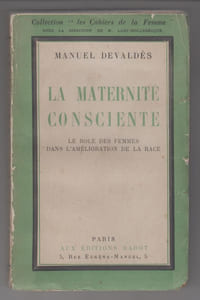
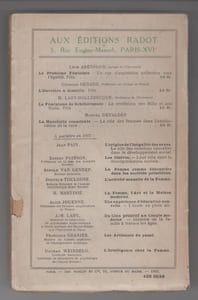
LA MATERNITÉ CONSCIENTE : le rôle des femmes dans l'amélioration de la race.Paris : Éditions Radot, Collection "Les Cahiers de la Femme", 1927, 1e édition. Broché 19x12cm, 218 pages, hommage de l'auteur par l'intermédiaire de sa maison d'édition, sous la forme d'un petit papier ronéotypé collé sur la première page de garde : "L'Auteur, étant en Angleterre, nous prie de vous faire parvenir, en hommage, cet ouvrage. LES ÉDITIONS RADOT". [Couverture frottée, petites déchirures, petits manques, rousseurs]
Les idées et les faits (eugénique, hérédité, hérédité morbide, crime et hérédité, stérilisation, milieu et race des pauvres, épuisement de la mère, facteur de dysgénisme, tare et génie, surpopulation et Guerre, dogme religieux contre la maternité consciente, éducation sexuelle, individualité féminine, association sexuelle, éthique de la maternité consciente) / L'action (exemples de la Grande-Bretagne, Suède, Allemagne, Autriche, Hollande, Etats-Unis, Inde, Chine, Japon, Russie). Écrivain libertaire, antimilitariste, pacifiste et néomalthusien, Manuel Devaldès (1875-1956) se réfugie en Angleterre au moment de la 1e guerre mondiale, revient en France en 1929 et consacre la majeure partie de ses travaux au néomalthusianisme. Poussant son raisonnement au risque de l'eugénisme, il estime que la course aux naissances est aussi absurde que la course aux armements, pointant du doigt le problème des guerres et de la surpopulation dans le monde, militant pour une régulation des naissances qui permettrait une meilleure répartition vivrière, cet objectif devant être réalisé par une génération "consciente" et une maternité "consciente", détachés des préceptes chrétiens du Décalogue ("Croissez et multipliez"), propageant ainsi l’oeuvre de pacification du monde et le salut de l'humanité.
Moulins la Marche, France
9,00 €
Livres
Référence : 13435GEORGES DEHERME
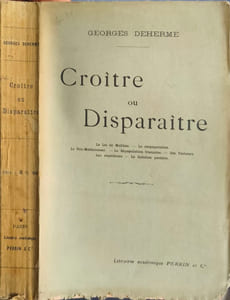
Croître ou disparaîtreLibrairie académique PERRIN et C° 1910 270 pages in12. 1910. broché. 270 pages. L'ouvrage de Georges Deherme publié en 1910 examine le problème de la dépopulation en France à travers le prisme des théories de Malthus. Il analyse la surpopulation le néo-malthusisme les facteurs de la dépopulation française et propose des solutions positives
Bon état couverture légèrement usagée intérieur trés propre

22,00 €
Livres
Référence : 19996LOUDON, Charles
SOLUTION DU PROBLÈME DE LA POPULATION ET DE LA SUBSISTANCE, soumise a un médecin dans une série de lettresParis Librairie Etrangère et Orientale de Girard Frères 1842 in 8 (22x14) 1 volume broché, couverture imprimée (défraichie et jaunie, petits manques de papier sur le dos), faux-titre, titre [1, table] 336 pages. Première édition (first edition). Rare. Bon exemplaire ( Photographies sur demande / We can send pictures of this book on simple request )
Saint André de Sangonis, France
260,00 €
Livres
Référence : RO40084321MALTHUS
ESSAI SUR LE PRINCIPE DE POPULATIONMediations. 1964. In-12. Broché. Etat d'usage, Couv. légèrement passée, Dos satisfaisant, Intérieur bon état. 236 pages. Page de titre manquante. Petite tache d'encre sur la tranche.. . . . Classification Dewey : 304.6-Démographie
Oui ou non le monde a-t-il faim ? Classification Dewey : 304.6-Démographie

Sablons, France
14,90 €
Livres
Référence : RO30314370Malthus
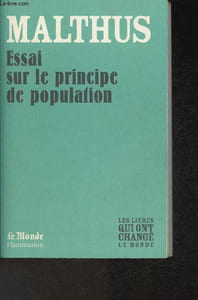
Essai sur le principe de populationFlammarion. 2010. In-8. Broché. Bon état, Couv. convenable, Dos satisfaisant, Intérieur frais. 284 pages.. . . . Classification Dewey : 301-Sociologie
Classification Dewey : 301-Sociologie
Sablons, France
19,80 €
Livres
Référence : 30964MALTHUS
Essai sur le principe de population.Un des ouvrages les plus influents de l'histoire de la pensée économique Paris & Genève, J. J. Paschoud, 1809. 3 vol. (120 x 195 mm) de 424, 395 et 392 p. Demi-veau brun, dos ornés de fleurons à froid et roulettes dorées, pièces de titre et de tomaison, tranches jaunes mouchetées (reliure légèrement postérieure). Édition originale de la traduction française.
Au début des années 1790, le philosophe anglais William Godwin expose un « principe de population ». Réagissant principalement à la thèse alors développée par Godwin, Malthus fait alors paraître la première édition de son Essai sur le principe de population, un pamphlet qui paraît - anonymement - en 1798. Il y substitue en 1803 ce qui se veut un traité plus scientifique, dans lequel il se réfère aussi à quatre autres sources importantes : Of the Populousness of Ancient Nations de David Hume, A Dissertation on the Numbers of Mankind de Robert Wallace, Observations on Reversionary Payments de Richard Price et An Inquiry into the Nature and Causes of the Wealth of Nations d'Adam Smith. Deux ans après cette parution, l'Essai fait l'objet d'une traduction partielle par le Suisse Pierre Prévost, qui fut professeur de physique et de philosophie à l'Université de Genève. Certains chapitres sont intégralement traduits, tandis que d'autres ne le sont que partiellement. Prévost accompagne sa traduction de notes et commentaires personnels ; encouragé par Malthus, il fait paraître en 1809 à Paris et à Genève cette nouvelle édition, la première complète, donnée d'après la dernière établie par Malthus en 1807 (la quatrième édition anglaise). « [Malthus] m'a même autorisé en conséquence à y faire les changements que j'estimer[a]is nécessaires. Je n'ai pas abusé de cette permission. Je me suis prescrit au contraire de faire connaître l'ouvrage de M. Malthus, tel qu'il l'a lui-même publié. L'appendice est la seule partie où j'ai fait des retranchements et quelques modifications, sans les indiquer en détail ; parce que les objections que l'auteur y discute m'ont paru quelquefois trop faibles ou trop particulières, pour mériter d'être exposées et réfutées dans une traduction, avec autant d'étendue qu'elles le sont dans l'original. Mais j'ai supprimé certains morceaux et même des chapitres entiers, qui s'écartent un peu du sujet principal ou qui sont trop immédiatement relatifs à l'Angleterre. » « L'Essai du révérend Malthus causa, en 1798, un véritable choc idéologique dans une Angleterre en crise, traumatisée par la Révolution française. Ce texte contient la première formulation - inchangée dans les cinq éditions suivantes - du principe de population. Avancée fondamentale, ce principe affirme que les vitesses de croissance de la population et des subsistances sont très différents, la première augmentant plus rapidement que la seconde .» (INED, préface à l'édition critique de 2017). Son analyse des crises de surproduction l'oppose à Jean-Baptiste Say et en fait un précurseur de Keynes - par l'accent qu'il met sur l'insuffisance de la demande - , ce dernier soulignant qu'il est « le premier des économistes de Cambridge ». Rare première traduction française de cette référence majeure dans l'histoire des idées. Bon exemplaire. De la bibliothèque Antoine Larue, avec ex-libris. Dirigeant de plusieurs entreprises de l'industrie chimique dans la deuxième partie du XXe siècle, sa bibliothèque sera dispersée en 1985 puis 1993, à l'Hôtel Drouot, par Claude Guérin. Printing and the Mind of Man, n° 251 (pour l'édition originale anglaise de 1798) ; Kress, B, 5591.



Orléans, France
1 200,00 €
Livres
Référence : 21481MALTHUS
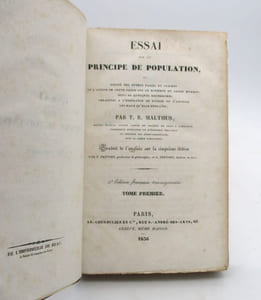
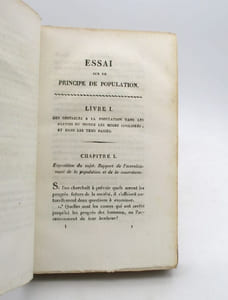
Essai sur le principe de populationParis, Ab. Cherbuliez et Cie, 1836. 4 vol. in-8, XXIII-434 pp. + 378 pp. +383 pp. + 374 pp., demi-basane havane d'Ottmann, dos à nerfs orné de filets dorés et à froid (minuscules épidermures, quelques rousseurs).
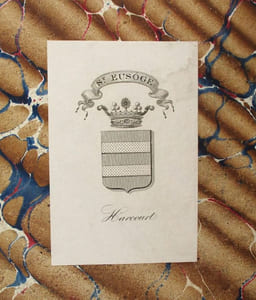
Troisième édition augmentée de la traduction de P. et G. Prévost, faite sur la cinquième édition anglaise, elle aussi augmentée. Dans l'avertissement des traducteurs, il est expliqué que la première traduction française était inexacte car son traducteur s'était permis de faire des retranchements et des modifications. La présente édition comprend la préface de Malthus à la deuxième édition qui explique la genèse de l'ouvrage ainsi que sa préface à la cinquième édition. Enfin, le dernier volume comprend les appendices, quelques réflexions du premier traducteur et la note finale des traducteurs de la présente édition. Complet de l'errata. Ex-libris héraldique des Harcourt, de la bibliothèque du château de St Eusoge, propriété de la famille. * Membre du SLAM et de la LILA / ILAB Member. La librairie est ouverte du lundi au vendredi de 14h à 19h. Merci de nous prévenir avant de passer,certains de nos livres étant entreposés dans une réserve.

Paris, France
500,00 €
Livres
Référence : R150030669MALTHUS.
ESSAI SUR LE PRINCIPE DE POPULATION. COLLECTION MEDIATIONS N° 23GONTHIER.. 1964.. In-12. Broché. Bon état, Couv. convenable, Dos satisfaisant, Intérieur frais. 236 pages. 1ère de couverture illustrée en couleurs.. . . . Classification Dewey : 300-SCIENCES SOCIALES
Classification Dewey : 300-SCIENCES SOCIALES

Sablons, France
10,95 €
Livres
Référence : 92984MALTHUS.
Essai sur le principe de population. Préface, introduction et traduction par le docteur Pierre Theil.Paris, Editions Seghers 1963, 210x135mm, 378pages, broché. Bel exemplaire.
Pour un paiement via PayPal, veuillez nous en faire la demande et nous vous enverrons une facture PayPal


Russy, Suisse
20,00 CHF
Livres
Référence : 99135MALTHUS, Francis, le Sieur.
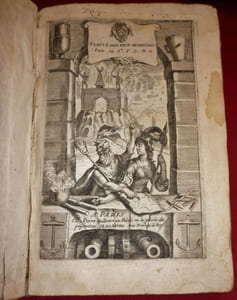
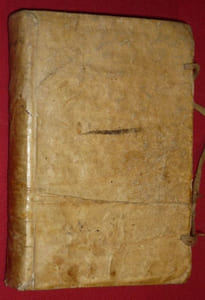
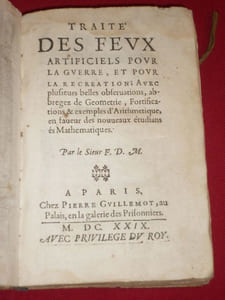
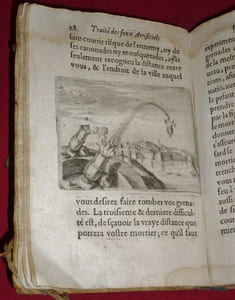
Traité des Feux artificiels pour la Guerre, et pour la Récréation; avec plusieurs belles observations, abrégez de Géométrie, Fortifications, et exemples d'Arithmétique en faveur des nouveaux étudians ès Mathématiques. Par le Sieur F.D.M.A Paris : chez Pierre Guillemot, 1629, 1 volume in-12 de 170x110 mm environ, 1 titre frontispice, (5) ff. (titre, épître, préface à Monseigneur l'illustrissime Cardinal de Riche-Lieu), 243 pages, (5) ff. (table, privilège), 2 feuillets blancs, plein parchemin crème portant titres manuscrits sur le dos, avec des liens de fermeture sur les plats. Contient : 28 figures gravées sur cuivre (y compris le frontispice), 7 figures sur bois (géométrie), 3 gravures pleine page, bandeaux et lettrines. Ex-libris manuscrits au-dessus de certains bandeaux (en partie découpés), dessins et notes manuscrites sur les dernières gardes blanches, mouillure dans la marge, manque un lien de fermeture.
Francis Malthus (16..?-1658)Gentilhomme anglais, commissaire des Feux et Artifices, au service de Louis XIII. - Fut à l'origine de l'utilisation du mortier dans l'armée française Merci de nous contacter à l'avance si vous souhaitez consulter une référence au sein de notre librairie.

Lyon, France
600,00 €
Livres
Référence : 51078"MALTHUS, T. R.
An Essay on the Principle of Population or, a View of its Past and Present Effects on Human Happiness. 3 vols. - [FIFTH EDITION OF ""AN ESSAY ON THE PRINCIPLE OF POPULATION""]London, John Murray, 1817. 8vo. Bound in three nice uniform contemporary half calf with five raised bands and gilt lettering to spine. Spines with wear. Front board and spine detached from book-block on volume 1. Ex-libris pasted on to pasted down front free end-paper on all three volumes. A fine set.
The fifth edition of this political and economic classic, which constitutes Malthus' first major publication and his main work, because of which he is considered the father of demography and one of the main sources of inspiration for Darwin and Wallace.This present fifth edition contain several important additions (price of grain) and the third chapter of Book III was completely rewritten. The book, then as now, is considered highly controversial, and it has influenced all demographers ever since, as well as being of immense importance to the study of economic theory and genetic inheritance. ""The ""Essay"" was highly influential in the progress of thought in the early nineteenth-century Europe.... ""Parson"" Malthus, as Cobbett dubbed him, was for many, a monster and his views were often grossly misinterpreted.... But his influence on social policy, whether for good or evil, was considerable. The Malthusian theory of population came at the right time to harden the existing feeling against the Poor Laws and Malthus was a leading spirit behind the Poor Law Amendment Act of 1834."" (PMM 251).Thomas Robert Malthus (1766-1834), called the ""enfant terrible"" of the economists, was an English demographer, statistician and political economist, who is best known for his groundbreaking views on population growth, presented in his ""Essays on the Principle of Population"", which is based on his own prediction that population would outrun food supply, causing poverty and starvation. Among other things this caused the legislation, which lowered the population of the poor in England. Malthus actually turned political, economic and social thought upside down with this work, which has caused him to be considered one of the 100 most influential persons in history (Hart, The 100: A Ranking of the most Influential Persons in History, 1978). Of course, he was condemned by Marx and Engels, and opposed by the socialists universally, but the work was of immense impact on not only politics, economics, social sciences etc, but also on natural sciences. ""Later in the ""Origin of Species"" he [Darwin] wrote that the struggle for existence ""is the doctrine of Malthus applied with manifold force to the whole animal and vegetable kingdoms"" for in this case there can be no artificial increase of food, and no prudential restraint from marriage"" [p. 63]. Alfred Russel Wallace, who arrived at a worked-out formulation of the theory of evolution at almost precisely the same time as Darwin, acknowledged that ""perhaps the most important book I read was Malthus's ""Principles of Population"" (My Life, p. 232). Although there were four decennial censuses before Malthus' death, he did not himself analyze the data, although he did influence Lambert Quetelet and Pierre Verhulst, who made precise statistical studies on growth of populations in developed countries and showed how the early exponential growth changed to an S curve."" (DSB, IX, p. 69). As Malthus realized that his theories were not satisfactorily presented or sufficiently demonstrated in the first edition from 1798, he travelled for three years through Europe gleaning statistics, and then published the second edition in 1803. Among other places he travelled through Northern Germany, and his detailed diaries of these journeys provided him with some of the evidence necessary for the development of his theory on population growth. The observational information that he gathered on his travels in Europe were crucial to the development of his theories, which also means that the work is of great interest for other European countries, and not only Britain. ""In 1819 the Royal Society elected Malthus to a fellowship. He was also a member of the French Institute and the Berlin Academy, and a founding member of the Statistical Society (1834)."" (DSB, IX, p. 67). Printing and the Mind of Man 251 (first edition). Einaudi 3670Mattioli 2210Goldsmith 21761Kress B6974
![An Essay on the Principle of Population or, a View of its Past and Present Effects on Human Happiness. 3 vols. - [FIFTH EDITION OF ""AN ESSAY ON THE PRINCIPLE OF POPULATION""]](https://static.livre-rare-book.com/pictures/LLX/51078_1.jpg?h=300)
![An Essay on the Principle of Population or, a View of its Past and Present Effects on Human Happiness. 3 vols. - [FIFTH EDITION OF ""AN ESSAY ON THE PRINCIPLE OF POPULATION""]](https://static.livre-rare-book.com/pictures/LLX/51078_2.jpg?h=300)
![An Essay on the Principle of Population or, a View of its Past and Present Effects on Human Happiness. 3 vols. - [FIFTH EDITION OF ""AN ESSAY ON THE PRINCIPLE OF POPULATION""]](https://static.livre-rare-book.com/pictures/LLX/51078_3.jpg?h=300)

Copenhagen, Danemark
2 500,00 DKK
Livres
Référence : 62792MALTHUS, T.R.
An Essay on the Principle of Population or, a View of its Past and Present Effects on Human Happiness" with an Inquiry into our Prospects Respecting the Future Removal or Mitigation of the Evils which it Occations. A New Edition, very much Enlarged. - [THE MAIN WORK ON POPULATION]London, Printed for J. Johnson, by T. Bensley, 1803. Large 4to. Later brown hcalf with four raised bands, single gilt lines and red leather title-label to spine. First three and last 14 leaves a bit brownspotted, title-page and last two leaves marginally repaired at hinge, otherwise a very nice, clean, and solid copy. VIII, (4), 610 pp.
The Great Quarto-edition of Malthus' milestone work, the first and most influential book on population. Although being the second edition, after the anonymously printed first of 1798, it is so significantly altered, revised, and expanded that it is considered a new work rather than a new edition. Malthus himself also thought of it as such. It is nearly four times the length of the 1798 essay, the title has been changed (the title of the first: ""An Essay on the Principle of Population, as it Affects the Future Improvement of Society with Remarks on the Speculation of Mr. Godwin, M. Condorcet, and Other Writers""), and it is published with Mathus' name as the author, not anonymously. All later editions were minor revisions of this heavily expanded and altered second one. ""In the course of this inquiry, I found that much more had been done, than I had been aware of, when I first published the essay. The poverty and misery arising from a too rapid increase of population, had been distinctly seen, and the most violent remedies proposed, so long ago as the times of Plato and Aristotle. And of late years, the subject had been treated in such a manner, by some of the French economists, occasionally by Montesquieu, and, among our own writers, by Dr. Franklin, Sir James Steuart, Mr. Arthur Young, and Mr. Townsend, as to create a natural surprise, that it had not excited more of the publick attention"" (Preface to the second edition, p. IV). The controversial views, because of which the work became so influential, are most provocative and eyeopening in the second edition, in which Malthus for instance for the first time advocates moral restraint (meaning sexual abstinence and late marriage) and elaborately explains his comparison between the increase of population and food. ""The ""Essay"" was highly influential in the progress of thought in the early nineteenth-century Europe.... ""Parson"" Malthus, as Cobbett dubbed him, was for many, a monster and his views were often grossly misinterpreted... But his influence on social policy, whether for good or evil, was considerable. The Malthusian theory of population came at the right time to harden the existing feeling against the Poor Laws and Malthus was a leading spirit behind the Poor Law Amendment Act of 1834."" (PMM 251). Thomas Robert Malthus (1766-1834), called the ""enfant terrible"" of the economists, was an English demographer, statistician and political economist, who is best known for his groundbreaking views on population growth, presented in his ""Essays on the Principle of Population"", which is based on his own prediction that population would outrun food supply, causing poverty and starvation. Among other things this caused the legislation, which lowered the population of the poor in England. Malthus actually turned political, economic, and social thought upside down with this work, which has caused him to be considered one of the 100 most influential persons in history (Hart, The 100: A Ranking of the most Influential Persons in History, 1978). Malthus was, naturally, condemned by Marx and Engels, and opposed by the socialists universally, but the work had an enormous impact on not only politics, economics, and social sciences, but also on natural sciences. For instance, both Darwin and Wallace considered Malthus a main source in their development of the theory of natural selection, considering him a great philosopher and his Essay on Population one of the most important books ever. ""Malthus’s idea of man’s ""Struggle for existence"" had decisive influence on Charles Darwin and the theory of evolution. Other scientists related this idea to plants and animals which helped to define a piece of the evolutionary puzzle. This struggle for existence of all creatures is the catalyst by which natural selection produces the ""survival of the fittest""... Thanks to Malthus, Darwin recognised the significance of intraspecies competition between populations of the same species (e.g. the lamb and the lamb), not just interspecies competition between species (e.g. the lion and the lamb). Malthusian population thinking also explained how an incipient species could become a full-blown species in a very short timeframe."" The second edition must be considered the most important of all the editions. This is far more a work on the problems of over-population than it is a response to Godwin and Condorcet on their works (whic is the main concern of the first edition). ""Not so much shocked by his own conclusions, in his ""Essay on Population"" (first ed. 1798), as driven by a naturally inquiring mind, he travelled for three years through Europe gleaning statistics and then published a second edition (1803)."" (Catlin, A History of the Political Philosophers, 1939, p. 377). PMM 251 (first edition).
![An Essay on the Principle of Population or, a View of its Past and Present Effects on Human Happiness" with an Inquiry into our Prospects Respecting the Future Removal or Mitigation of the Evils which it Occations. A New Edition, very much Enlarged. - [THE MAIN WORK ON POPULATION]](https://static.livre-rare-book.com/pictures/LLX/62792_1.jpg?h=300)
![An Essay on the Principle of Population or, a View of its Past and Present Effects on Human Happiness" with an Inquiry into our Prospects Respecting the Future Removal or Mitigation of the Evils which it Occations. A New Edition, very much Enlarged. - [THE MAIN WORK ON POPULATION]](https://static.livre-rare-book.com/pictures/LLX/62792_2.jpg?h=300)
![An Essay on the Principle of Population or, a View of its Past and Present Effects on Human Happiness" with an Inquiry into our Prospects Respecting the Future Removal or Mitigation of the Evils which it Occations. A New Edition, very much Enlarged. - [THE MAIN WORK ON POPULATION]](https://static.livre-rare-book.com/pictures/LLX/62792_3.jpg?h=300)
![An Essay on the Principle of Population or, a View of its Past and Present Effects on Human Happiness" with an Inquiry into our Prospects Respecting the Future Removal or Mitigation of the Evils which it Occations. A New Edition, very much Enlarged. - [THE MAIN WORK ON POPULATION]](https://static.livre-rare-book.com/pictures/LLX/62792_4.jpg?h=300)
Copenhagen, Danemark
32 000,00 DKK
Livres
Référence : ORD-16020MALTHUS T. R.-
Essai sur le Principe de Population où Exposé des effets passés et présens de l'action de cette cause sur le bonheur du genre humain; suivi de quelques recherches relatives à l'espérance de guérir ou d'adoucir les mauxqu'elle entraîne.- Traduit de l'anglois par Pierre Prévost. TOME PREMIER SEUL. Paris. Genève. Paschoud. 1809. In-8 (137 216mm) broché, couverture d'attente d'origine de papier vert, étiquette de titre au dos, XXIII, 424, (3) pages et 1 page de catalogue du libraire. Pages cornées, bords de feuille du fx-titre et de la dernière page poussiéreux sinon bon état intérieur, exemplaire non rogné, pourrait être relié. Edition originale de la traduction française. Tome I seul sur 3.
Toulon, France
150,00 €
Livres
Référence : 31327MALTHUS, T.R.
Essai sur le principe de population, ou Exposé des effets passés at présens de l'action de cette cause sur le bonheur du genre humain suivi de quelques recherches relatives à l'espérance de guérir ou d'adoucir les maux qu'elle entraîne. Traduit ... - [ESTABLISHING DEMOGRAPHY]Paris & Genève, Chez J.J. Paschoud, 1809. 8vo. Bound in three nice uniform cont. hcalfbdgs. w. gilt backs, red leather title-labels w. gilt lettering and gilt round green tome-labels on backs. Capitals w. a bit of wear. Internally nice and clean. W. half-titles in all three volumes and advertisement-leaf in vol. one. XIII, (1), 424, (5) (6), 395, (1) (4), 392 pp.
First French edition of this political and economic classic, which constitutes Malthus' first major publication and his main work, because of which he is considered the father of demography and the main source of inspiration of Darwin and Wallace.The first edition was printed anonymously in London in 1798, and in 1803 the second edition, which also according to Malthus himself can be said to constitute a new work, appeared" -the great quarto edition from 1803 is thoroughly revised and much enlarged, the title has been changed and Malthus' name appears on the title-page, it is on this edition that all the preceding editions are based, and in consequence also the early translations. All the later editions were minor revisions of the second one. In 1807 the fourth edition appeared, and in 1809 the first French one, which is translated from the revised fourth edition (""A la suite de cette préface on trouve dans la 4.e édition, sur laquelle je traduis, une notice de tous les changements que la 3.e édition a apportés à la 2.e. Le plus considérable est celui qui a rapport à l'estimation de la fécondité des mariages. Il est absolument inutile pour les lecteurs francois de connoître le détail minutieux des autres changemens, qui ne peuvent intéresser que les acquéreurs des précédentes éditions. P.P.p"", Préface, p. xxiij). New revisions of the text kept appearing till the sixth edition in 1826.The book, then as now, is considered highly controversial, and it has influenced all demographers ever since, as well as being of immense importance to the study of economic theory and genetic inheritance. ""The ""Essay"" was highly influential in the progress of thought in the early nineteenth-century Europe.... ""Parson"" Malthus, as Cobbett dubbed him, was for many, a monster and his views were often grossly misinterpreted.... But his influence on social policy, whether for good or evil, was considerable. The Malthusian theory of population came at the right time to harden the existing feeling against the Poor Laws and Malthus was a leading spirit behind the Poor Law Amendment Act of 1834."" (PMM 251).Thomas Robert Malthus (1766-1834), called the ""enfant terrible"" of the economists, was an English demographer, statistician and political economist, who is best known for his groundbreaking views on population growth, presented in his ""Essays on the Principle of Population"", which is based on his own prediction that population would outrun food supply, causing poverty and starvation. Among other things this caused the legislation, which lowered the population of the poor in England. Malthus actually turned political, economic and social thought upside down with this work, which has caused him to be considered one of the 100 most influential persons in history (Hart, The 100: A Ranking of the most Influential Persons in History, 1978). Of course, he was condemned by Marx and Engels, and opposed by the socialists universally, but the work was of immense impact on not only politics, economics, social sciences etc, but also on natural sciences. ""Later in the ""Origin of Species"" he [Darwin] wrote that the struggle for existence ""is the doctrine of Malthus applied with manifold force to the whole animal and vegetable kingdoms"" for in this case there can be no artificial increase of food, and no prudential restraint from marriage"" [p. 63]. Alfred Russel Wallace, who arrived at a worked-out formulation of the theory of evolution at almost precisely the same time as Darwin, acknowledged that ""perhaps the most important book I read was Malthus's ""Principles of Population"" (My Life, p. 232). Although there were four decennial censuses before Malthus' death, he did not himself analyze the data, although he did influence Lambert Quetelet and Pierre Verhulst, who made precise statistical studies on growth of populations in developed countries and showed how the early exponential growth changed to an S curve."" (DSB, IX, p. 69).As Malthus realized that his theories were not satisfactorily presented or sufficiently demonstrated in the first edition from 1798, he travelled for three years through Europe gleaning statistics, and then published the second edition in 1803. Among other places he travelled through France and Switzerland in 1802, and his detailed diaries of these journeys provided him with some of the evidence necessary for the development of his theory on population growth. The observational information that he gathered on his travels in Europe were crucial to the development of his theories, which also means that the work is of great interest for other European countries, and not only Britain. ""In 1819 the Royal Society elected Malthus to a fellowship. He was also a member of the French Institute and the Berlin Academy, and a founding member of the Statistical Society (1834)."" (DSB, IX, p. 67). Printing and the Mind of Man 251
Copenhagen, Danemark
38 000,00 DKK
Livres
Référence : 31326MALTHUS, T.R.
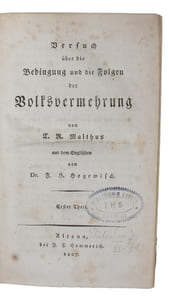
Versuch über die Bedingung und die Folgen der Volksvermehrung, aus dem Englischen von Dr. F.H. Hegewisch. 2 Tle. - [DECREASING POPULATION GROWTH]Altona, J.F. Hammerich, 1807. 8vo. Bound in the two orig. blue cardboardbindings. The backs have been professionally restored, preserving the orig. printed paper title-labels and cont. paper library-labels at lower backs. Occasional brownspotting due to the paper-quality, but all in all a very nice and attractive copy. XVI, (4), 368" VIII, 358, (1) pp. Some of the first leaves of the ""Erstes Buch"" in the first volume have been misbound, but are all present.
Rare first German edition of this political and economic classic, which constitutes Malthus' first major publication and his main work, because of which he is considered the father of demography and one of the main sources of inspiration for Darwin and Wallace. It is the first translation of the ""Principle on Population"" into any language, and it influenced German politics tremendously.The first edition was printed anonymously in London in 1798, and in 1803 the second edition, which, also according to Malthus himself, can be said to constitute a new work, appeared"" -the great quarto edition from 1803 is thoroughly revised and much enlarged, the title has been changed and Malthus' name appears on the title-page for the first time, it is on this edition that all the preceding editions are based, and in consequence also the early translations. All the later editions were minor revisions of the second one. In 1806 the third edition appeared, and as soon as 1807 the first German one, which is translated from the revised third edition (""Die gegenwärtige Uebersetzung ist nach der dritten Ausgabe, Oktav, London 1806. Die Quartausgabe ist minder vollständig"", Vorwort, p. V). New revisions of the text kept appearing till the sixth edition in 1826. The book, then as now, is considered highly controversial, and it has influenced all demographers ever since, as well as being of immense importance to the study of economic theory and genetic inheritance. ""The ""Essay"" was highly influential in the progress of thought in the early nineteenth-century Europe.... ""Parson"" Malthus, as Cobbett dubbed him, was for many, a monster and his views were often grossly misinterpreted.... But his influence on social policy, whether for good or evil, was considerable. The Malthusian theory of population came at the right time to harden the existing feeling against the Poor Laws and Malthus was a leading spirit behind the Poor Law Amendment Act of 1834."" (PMM 251).Thomas Robert Malthus (1766-1834), called the ""enfant terrible"" of the economists, was an English demographer, statistician and political economist, who is best known for his groundbreaking views on population growth, presented in his ""Essays on the Principle of Population"", which is based on his own prediction that population would outrun food supply, causing poverty and starvation. Among other things this caused the legislation, which lowered the population of the poor in England. Malthus actually turned political, economic and social thought upside down with this work, which has caused him to be considered one of the 100 most influential persons in history (Hart, The 100: A Ranking of the most Influential Persons in History, 1978). Of course, he was condemned by Marx and Engels, and opposed by the socialists universally, but the work was of immense impact on not only politics, economics, social sciences etc, but also on natural sciences. ""Later in the ""Origin of Species"" he [Darwin] wrote that the struggle for existence ""is the doctrine of Malthus applied with manifold force to the whole animal and vegetable kingdoms"" for in this case there can be no artificial increase of food, and no prudential restraint from marriage"" [p. 63]. Alfred Russel Wallace, who arrived at a worked-out formulation of the theory of evolution at almost precisely the same time as Darwin, acknowledged that ""perhaps the most important book I read was Malthus's ""Principles of Population"" (My Life, p. 232). Although there were four decennial censuses before Malthus' death, he did not himself analyze the data, although he did influence Lambert Quetelet and Pierre Verhulst, who made precise statistical studies on growth of populations in developed countries and showed how the early exponential growth changed to an S curve."" (DSB, IX, p. 69). As Malthus realized that his theories were not satisfactorily presented or sufficiently demonstrated in the first edition from 1798, he travelled for three years through Europe gleaning statistics, and then published the second edition in 1803. Among other places he travelled through Northern Germany, and his detailed diaries of these journeys provided him with some of the evidence necessary for the development of his theory on population growth. The observational information that he gathered on his travels in Europe were crucial to the development of his theories, which also means that the work is of great interest for other European countries, and not only Britain. ""In 1819 the Royal Society elected Malthus to a fellowship. He was also a member of the French Institute and the Berlin Academy, and a founding member of the Statistical Society (1834)."" (DSB, IX, p. 67). Printing and the Mind of Man 251 (first edition).
Copenhagen, Danemark
48 000,00 DKK
Livres
Référence : 36928"MALTHUS, T.R.
Versuch über die Bedingung und die Folgen der Volksvermehrung, aus dem Englischen von Dr. F.H. Hegewisch. 2 Tle. - [DECREASING POPULATION GROWTH]Altona, J.F. Hammerich, 1807. 8vo. Bound in the two nice cont. uniform cardboardbindings w. marbled paper. Gilt lines and gilt title-labels to spines. Some wear w. minor loss of paper to capitals, hinges and corners. Small hole to paper as well as to leather title-label of spine of volume two. Some brownspotting, but overall a nice and atrractive copy. Lacking the half-tilte for the first book (merely stating ""Erstes Buch""). XVI, 368"" VIII, 358, (1) pp.
Rare first German edition of this political and economic classic, which constitutes Malthus' first major publication and his main work, because of which he is considered the father of demography and one of the main sources of inspiration for Darwin and Wallace. It is the first translation of the ""Principle on Population"" into any language, and it influenced German politics tremendously.The first edition was printed anonymously in London in 1798, and in 1803 the second edition, which, also according to Malthus himself, can be said to constitute a new work, appeared"" -the great quarto edition from 1803 is thoroughly revised and much enlarged, the title has been changed and Malthus' name appears on the title-page for the first time, it is on this edition that all the preceding editions are based, and in consequence also the early translations. All the later editions were minor revisions of the second one. In 1806 the third edition appeared, and as soon as 1807 the first German one, which is translated from the revised third edition (""Die gegenwärtige Uebersetzung ist nach der dritten Ausgabe, Oktav, London 1806. Die Quartausgabe ist minder vollständig"", Vorwort, p. V). New revisions of the text kept appearing till the sixth edition in 1826. The book, then as now, is considered highly controversial, and it has influenced all demographers ever since, as well as being of immense importance to the study of economic theory and genetic inheritance. ""The ""Essay"" was highly influential in the progress of thought in the early nineteenth-century Europe.... ""Parson"" Malthus, as Cobbett dubbed him, was for many, a monster and his views were often grossly misinterpreted.... But his influence on social policy, whether for good or evil, was considerable. The Malthusian theory of population came at the right time to harden the existing feeling against the Poor Laws and Malthus was a leading spirit behind the Poor Law Amendment Act of 1834."" (PMM 251).Thomas Robert Malthus (1766-1834), called the ""enfant terrible"" of the economists, was an English demographer, statistician and political economist, who is best known for his groundbreaking views on population growth, presented in his ""Essays on the Principle of Population"", which is based on his own prediction that population would outrun food supply, causing poverty and starvation. Among other things this caused the legislation, which lowered the population of the poor in England. Malthus actually turned political, economic and social thought upside down with this work, which has caused him to be considered one of the 100 most influential persons in history (Hart, The 100: A Ranking of the most Influential Persons in History, 1978). Of course, he was condemned by Marx and Engels, and opposed by the socialists universally, but the work was of immense impact on not only politics, economics, social sciences etc, but also on natural sciences. ""Later in the ""Origin of Species"" he [Darwin] wrote that the struggle for existence ""is the doctrine of Malthus applied with manifold force to the whole animal and vegetable kingdoms"" for in this case there can be no artificial increase of food, and no prudential restraint from marriage"" [p. 63]. Alfred Russel Wallace, who arrived at a worked-out formulation of the theory of evolution at almost precisely the same time as Darwin, acknowledged that ""perhaps the most important book I read was Malthus's ""Principles of Population"" (My Life, p. 232). Although there were four decennial censuses before Malthus' death, he did not himself analyze the data, although he did influence Lambert Quetelet and Pierre Verhulst, who made precise statistical studies on growth of populations in developed countries and showed how the early exponential growth changed to an S curve."" (DSB, IX, p. 69). As Malthus realized that his theories were not satisfactorily presented or sufficiently demonstrated in the first edition from 1798, he travelled for three years through Europe gleaning statistics, and then published the second edition in 1803. Among other places he travelled through Northern Germany, and his detailed diaries of these journeys provided him with some of the evidence necessary for the development of his theory on population growth. The observational information that he gathered on his travels in Europe were crucial to the development of his theories, which also means that the work is of great interest for other European countries, and not only Britain. ""In 1819 the Royal Society elected Malthus to a fellowship. He was also a member of the French Institute and the Berlin Academy, and a founding member of the Statistical Society (1834)."" (DSB, IX, p. 67). Printing and the Mind of Man 251 (first edition).
Copenhagen, Danemark
35 000,00 DKK
Livres
Référence : 60615MALTHUS, T.R.
Versuch über die Bedingung und die Folgen der Volksvermehrung, aus dem Englischen von Dr. F.H. Hegewisch. 2 vols. - [DECREASING POPULATION GROWTH]Altona, J.F. Hammerich, 1807. 8vo. 2 volumes both uncut in the original blank wrappers. Wear to extremities, front wrapper on vol. 1 detached and with tear. Missing ab. half of the paper on spines. Internally fine and clean. XVI, 368" VIII, 358, (1) pp.
Rare first German edition of this political and economic classic, which constitutes Malthus' first major publication and his main work, because of which he is considered the father of demography and one of the main sources of inspiration for Darwin and Wallace. It is the first translation of the ""Principle on Population"" into any language, and it influenced German politics tremendously.The first edition was printed anonymously in London in 1798, and in 1803 the second edition, which, also according to Malthus himself, can be said to constitute a new work, appeared"" -the great quarto edition from 1803 is thoroughly revised and much enlarged, the title has been changed and Malthus' name appears on the title-page for the first time, it is on this edition that all the preceding editions are based, and in consequence also the early translations. All the later editions were minor revisions of the second one. In 1806 the third edition appeared, and as soon as 1807 the first German one, which is translated from the revised third edition (""Die gegenwärtige Uebersetzung ist nach der dritten Ausgabe, Oktav, London 1806. Die Quartausgabe ist minder vollständig"", Vorwort, p. V). New revisions of the text kept appearing till the sixth edition in 1826. The book, then as now, is considered highly controversial, and it has influenced all demographers ever since, as well as being of immense importance to the study of economic theory and genetic inheritance. ""The ""Essay"" was highly influential in the progress of thought in the early nineteenth-century Europe.... ""Parson"" Malthus, as Cobbett dubbed him, was for many, a monster and his views were often grossly misinterpreted.... But his influence on social policy, whether for good or evil, was considerable. The Malthusian theory of population came at the right time to harden the existing feeling against the Poor Laws and Malthus was a leading spirit behind the Poor Law Amendment Act of 1834."" (PMM 251).Thomas Robert Malthus (1766-1834), called the ""enfant terrible"" of the economists, was an English demographer, statistician and political economist, who is best known for his groundbreaking views on population growth, presented in his ""Essays on the Principle of Population"", which is based on his own prediction that population would outrun food supply, causing poverty and starvation. Among other things this caused the legislation, which lowered the population of the poor in England. Malthus actually turned political, economic and social thought upside down with this work, which has caused him to be considered one of the 100 most influential persons in history (Hart, The 100: A Ranking of the most Influential Persons in History, 1978). Of course, he was condemned by Marx and Engels, and opposed by the socialists universally, but the work was of immense impact on not only politics, economics, social sciences etc, but also on natural sciences. ""Later in the ""Origin of Species"" he [Darwin] wrote that the struggle for existence ""is the doctrine of Malthus applied with manifold force to the whole animal and vegetable kingdoms"" for in this case there can be no artificial increase of food, and no prudential restraint from marriage"" [p. 63]. Alfred Russel Wallace, who arrived at a worked-out formulation of the theory of evolution at almost precisely the same time as Darwin, acknowledged that ""perhaps the most important book I read was Malthus's ""Principles of Population"" (My Life, p. 232). Although there were four decennial censuses before Malthus' death, he did not himself analyze the data, although he did influence Lambert Quetelet and Pierre Verhulst, who made precise statistical studies on growth of populations in developed countries and showed how the early exponential growth changed to an S curve."" (DSB, IX, p. 69). As Malthus realized that his theories were not satisfactorily presented or sufficiently demonstrated in the first edition from 1798, he travelled for three years through Europe gleaning statistics, and then published the second edition in 1803. Among other places he travelled through Northern Germany, and his detailed diaries of these journeys provided him with some of the evidence necessary for the development of his theory on population growth. The observational information that he gathered on his travels in Europe were crucial to the development of his theories, which also means that the work is of great interest for other European countries, and not only Britain. ""In 1819 the Royal Society elected Malthus to a fellowship. He was also a member of the French Institute and the Berlin Academy, and a founding member of the Statistical Society (1834)."" (DSB, IX, p. 67). Printing and the Mind of Man 251 (first edition).
Copenhagen, Danemark
32 000,00 DKK
Livres
Référence : 52195MALTHUS, T.R. - DECREASING POPULATION GROWTH.
Versuch über die Bedingung und die Folgen der Volksvermehrung, aus dem Englischen von Dr. F.H. Hegewisch. 2 Theile.Altona, J.F. Hammerich, 1807. Contemp. hcalf. Gilt spine, titlelabel in leather (letters worn). Light wear to top of spine and corners. Spine rubbed. Some wear to edges of covers. A stamp on title-page. XVI, 368" VIII, 358, (2) pp. A few leaves in the first quire disbound. Scattered brownspots and a few marginal underlinings on the first 20 leaves.
Rare first German edition of this political and economic classic, which constitutes Malthus' first major publication and his main work, because of which he is considered the father of demography and one of the main sources of inspiration for Darwin and Wallace. It is the first translation of the ""Principle on Population"" into any language, and it influenced German politics tremendously.The first edition was printed anonymously in London in 1798, and in 1803 the second edition, which, also according to Malthus himself, can be said to constitute a new work, appeared"" -the great quarto edition from 1803 is thoroughly revised and much enlarged, the title has been changed and Malthus' name appears on the title-page for the first time, it is on this edition that all the preceding editions are based, and in consequence also the early translations. All the later editions were minor revisions of the second one. In 1806 the third edition appeared, and as soon as 1807 the first German one, which is translated from the revised third edition (""Die gegenwärtige Uebersetzung ist nach der dritten Ausgabe, Oktav, London 1806. Die Quartausgabe ist minder vollständig"", Vorwort, p. V). New revisions of the text kept appearing till the sixth edition in 1826. The book, then as now, is considered highly controversial, and it has influenced all demographers ever since, as well as being of immense importance to the study of economic theory and genetic inheritance. ""The ""Essay"" was highly influential in the progress of thought in the early nineteenth-century Europe.... ""Parson"" Malthus, as Cobbett dubbed him, was for many, a monster and his views were often grossly misinterpreted.... But his influence on social policy, whether for good or evil, was considerable. The Malthusian theory of population came at the right time to harden the existing feeling against the Poor Laws and Malthus was a leading spirit behind the Poor Law Amendment Act of 1834."" (PMM 251).Thomas Robert Malthus (1766-1834), called the ""enfant terrible"" of the economists, was an English demographer, statistician and political economist, who is best known for his groundbreaking views on population growth, presented in his ""Essays on the Principle of Population"", which is based on his own prediction that population would outrun food supply, causing poverty and starvation. Among other things this caused the legislation, which lowered the population of the poor in England. Malthus actually turned political, economic and social thought upside down with this work, which has caused him to be considered one of the 100 most influential persons in history (Hart, The 100: A Ranking of the most Influential Persons in History, 1978). Of course, he was condemned by Marx and Engels, and opposed by the socialists universally, but the work was of immense impact on not only politics, economics, social sciences etc, but also on natural sciences. ""Later in the ""Origin of Species"" he [Darwin] wrote that the struggle for existence ""is the doctrine of Malthus applied with manifold force to the whole animal and vegetable kingdoms"" for in this case there can be no artificial increase of food, and no prudential restraint from marriage"" [p. 63]. Alfred Russel Wallace, who arrived at a worked-out formulation of the theory of evolution at almost precisely the same time as Darwin, acknowledged that ""perhaps the most important book I read was Malthus's ""Principles of Population"" (My Life, p. 232). Although there were four decennial censuses before Malthus' death, he did not himself analyze the data, although he did influence Lambert Quetelet and Pierre Verhulst, who made precise statistical studies on growth of populations in developed countries and showed how the early exponential growth changed to an S curve."" (DSB, IX, p. 69). As Malthus realized that his theories were not satisfactorily presented or sufficiently demonstrated in the first edition from 1798, he travelled for three years through Europe gleaning statistics, and then published the second edition in 1803. Among other places he travelled through Northern Germany, and his detailed diaries of these journeys provided him with some of the evidence necessary for the development of his theory on population growth. The observational information that he gathered on his travels in Europe were crucial to the development of his theories, which also means that the work is of great interest for other European countries, and not only Britain. ""In 1819 the Royal Society elected Malthus to a fellowship. He was also a member of the French Institute and the Berlin Academy, and a founding member of the Statistical Society (1834)."" (DSB, IX, p. 67). Printing and the Mind of Man 251 (first edition).

Copenhagen, Danemark
28 500,00 DKK
Livres
Référence : RO80260974Malthus Thomas Robert
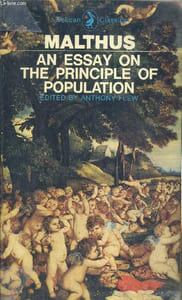
An essay on the principle of population and A summary viw of the principle of populationPenguin Books. 1979. In-12. Broché. Bon état, Couv. convenable, Dos satisfaisant, Papier jauni. 291 pages. Annotation au stylo en page de titre. Texte en anglais.. . . . Classification Dewey : 420-Langue anglaise. Anglo-saxon
Classification Dewey : 420-Langue anglaise. Anglo-saxon
Sablons, France
10,95 €
Livres
Référence : 125826MALTHUS (Thomas Robert).
Essai sur le principe de population.Seghers, 1963, in-8°, 373 pp, préface, introduction et traduction par le docteur Pierre Theil, broché, couv. illustrée, bon état
Traduction partielle du second Essai, paru en 1803, avec une substantielle introduction de Pierre Theil. Ce traité d'allure scientifique est une sociologie de la population : les principes de base en sont que la population s'accroît en progression géométrique, les subsistances en progression arithmétique ; la difficulté de se nourrir forme un frein puissant ; le vice et la misère freinent la multiplication de la population ; le principe de population empêche la perfectibilité de la société; les lois des pauvres multiplient la pauvreté... Désormais les frais d'envoi sont de 6 € seulement pour les livres jusqu'à 1 kg (colissimo suivi), pour la France métropolitaine.


Paris, France
25,00 €
Livres
Référence : 17039MALTHUS Thomas-Robert
Essai sur le principe de populationGonthier 1964 236 pages collection Médiations. in-12. 1964. broché. 236 pages.
Etat correct. Couverture en état correct avec le dos bruni. Intérieur propre un peu jauni

12,00 €
Livres
Référence : R300278306Malthus Thomas Robert
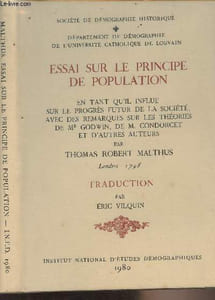
Essai sur le principe de population en tant qu'il influe sur le progrès futur de la société, avec des remarques sur les théories de Mr Godwin, de M.Condorcet et d'autres auteurs - Société de démographie historiqueInstitut national d'études démographiques. 1980. In-8. Relié. Bon état, Couv. convenable, Dos satisfaisant, Intérieur acceptable. 166 pages. Jaquette convenable.. Avec Jaquette. . . Classification Dewey : 304.6-Démographie
Département de démographie de l'université catholique de Louvain. Trad. de Eric Vilquin. Classification Dewey : 304.6-Démographie
Sablons, France
39,80 €
Livres
Référence : 104587MALTHUS (Thomas Robert).
Essai sur le principe de population, en tant qu'il influe sur le progrès futur de la société. Avec des remarques sur les théories de Mr Godwin, de M. Condorcet et d'autres auteurs. (Londres, 1798).P., INED, 1980, gr. in-8°, 166 pp, traduction par Eric Vilquin, avant-propos de Jacques Dupâquier, reliure toile crème imprimée de l'éditeur (salie), état correct (Société de démographie historique. Département de démographie de l'Université catholique de Louvain)
Réimpression de la 1ère édition de l'ouvrage de Malthus – parue sans nom d'auteur –, qui fit scandale en Angleterre. — "Malthus est le père d'une doctrine, le malthusianisme, dont le nom est connu à la fois des savants et du grand public, mais dont le contenu est ignoré de la plupart. Il devenait urgent d'éditer la traduction française de son Essai sur le principe de population. Remarquons que les précédentes traductions, datant du siècle dernier, furent faites sur les éditions ultérieures d'un ouvrage dont le titre commence par les mêmes mots mais qui est en réalité totalement différent de celui qui nous occupe. Nous lisons donc ici la première traduction du premier Essai que Malthus publia en 1798, sans nom d'auteur. Il s'agit d'un pamphlet provocant qui fit scandale, tandis que le second Essai, paru en 1803, est un traité d'allure scientifique, une sociologie de la population. Or, ce pamphlet philosophique incorpore en germe la théorie de la population qui allait être développée plus tard. Les principes de base sont déjà énoncés dans les premiers chapitres : la population s'accroît en progression géométrique, les subsistances en progression arithmétique; la difficulté de se nourrir forme un frein puissant ; le vice et la misère freinent la multiplication de la population ; le principe de population empêche la perfectibilité de la société; les lois des pauvres multiplient la pauvreté..." (André Reix, Revue Philosophique de Louvain, 1981) Désormais les frais d'envoi sont de 6 € seulement pour les livres jusqu'à 1 kg (colissimo suivi), pour la France métropolitaine.
Paris, France
25,00 €
Livres
Référence : CLL-280"MALTHUS, Thomas-Robert;"
"Essai sur le principe de population, ou exposé des effets passés et présens de l'action de cette cause sur le bonheur du genre humain ; suivi de quelques recherches relatives à l'espérance de guérir ou d'adoucir les maux qu'elle entraine."Genève, J.-J. Paschoud, 1809 3 tomes en un volume in-8 de XXIII, (1), 424, (6) - (4), 395, (3) - (4), 392 pp., 16 pp. de catalogue d'éditeur, demi-veau havane, dos lisse orné de filets, roulettes et palettes dorés, tranches paille (reliure de l'époque).
"Édition originale de la traduction française due à Pierre Prévost de Genève. Un des ouvrages phares de la science économique et démographique qui connut un immense succès en raison de la polémique qu'il entraina. Malthus pose l'idée du contrôle de la démographie et de la limitation de l'accroissement de la population afin de pouvoir maîtriser les ponctions sur les ressources. Il sera ""canonisé"" en tant qu'économiste de l'école classique aux côtés d'Adam Smith et de David Ricardo. ""Thomas Robert Malthus (1766-1834) était pasteur et professeur d'histoire et d'économie politique à l'East India College à Haileybury. […] Il a surgit de la plus complète obscurité pour atteindre la renommée, en 1798, quand il a publié son Essay on the Principle of Population."" (Schumpeter, Histoire de l'analyse économique). Bel exemplaire en reliure strictement contemporaine. En fin volume, catalogue de l'éditeur Paschoud à Genève. De la bibliothèque P. Tissot avec timbre humide sur les titres de chaque partie."

Paris, France
2 500,00 €
Catalogue thématique
- Lebon André
- Lebret L.J.
- Lecache Bernard
- Leclercq Paul
- Ledru-Rollin
- Lefebvre Edmond
- Le Foyer Jean
- Lefranc Georges
- Lelong Pierre
- Léninisme
- Léonard Jacques
- Le Play F.
- Le Provost de Launay Louis-Auguste
- Le Roux Hugues
- Leroux Pierre
- Leroy-Beaulieu Anatole
- Le Roy Ladurie Jacques
- Leroy Maxime
- Leroy Roland
- Letamendia Pierre
- Levillain Philippe
- Lévy Paul
- Lewinsohn Richard
- Leygues Jacques Raphaël
- Libéralisme
- Libre Pensée
- Liebknecht Karl
- Lincoln Abraham
- Lolme Jean Louis de
- London Arthur
- Lop Ferdinand
- Loubet Émile
- Louis Paul
- Louvet Louis
- Luppe Comte de
- Lüthy Herbert
- Luttes Sociales
- Lysis
- Mac Carthy
- Maccarthysme
- MacGregor-Hastie Roy
- Machiavel Nicolas
- Madjarian Grégoire
- Magallon Xavier de
- Maire Madeleine
- Maistre Joseph de
- Maitron Jean
- Makhno Nestor
- Malatesta
- Malon Benoît
- Mandela Nelson
- Mandel Ernest
- Man Henri de
- Manuel Pierre
- Maoïsme
- Mao Tsé-Toung
- Marcireau Jacques
- Marcou Lilly
- Marie Jean-Jacques
- Marion Marcel
- Marion Paul
- Marlio Louis
- Martin Alfred
- Martin Léon
- Marxisme
- Marx Karl
- Masaryk
- Massis Henri
- Maurras Charles
- Mazé Pierre
- Médard Jean-Marie
- Medvedev Jaurès
- Melchior-Bonnet Sabine
- Méric Victor
- Méry Gaston
- Mestre Philippe
- Meyrac Albert
- Michaud Louis
- Milhaud Edgard
- Millet René
- Minc Alain
- Mirman Léon
- Missiroli Mario
- Moch Gaston
- Moch Maurice
- Mœurs et coutumes
- Mollet Guy
- Molnar Thomas
- Monarchie, la
- Monod Gabriel
- Monteil A. A.
- Montlosier M. le Comte de
- Monzie Eugène de
- Morazé Charles
- Morizet André
- Mosley Oswald
- Mouilleseaux Louis
- Moulin Charles du
- Mousset Albert