Einstein Albert
435 livres
Livres
Référence : 106283aafEINSTEIN, A. (Albert 1879-1955):
Sidelights on Relativity. I. Ether and Relativity. II. Geometry and Experience. Translated by G. B. Jeffery, D.Sc., and W. Perrett, Ph. D.London: Methuen & Co.Ltd, 1922, sm. in-8vo, 2 leaves (halftitle & titlepage) + 56 p. + 2 leaves + 8 p. publicity on diff. paper, printed on heavy paper, slightly yellowed, Ex-Libris ‘Edward Wilder Playfair’, full cloth publisher’s binding, blind-stamped title to front, gilt title to spine, spine sunned.
This two lectures were delivered on May 5th, 1920, in the University of Leyden. Its importance was immediately recognized and it was translated into Italian, French, English, Polish, Russian and Hungarian in quick succession. for the first ed. in German cf. Weil 111; Schlipp-Shields n° 131; Alicke 97.
Fribourg, Suisse
150,00 CHF
Livres
Référence : 46540"EINSTEIN, A. (+) E. RUPP.
Über die Interferenzeigenschaften des durch Kanalstrahlen emittierten Lichtes [Einstein] (+) Über die Interferenzeigenschaften des Kanalstrahllichtes [Rupp]. Offprint from ""Sitzungsberichte der Preussischen Akademie der Wissenschaften"", XXV, 1926. - [THE GREATEST SCANDAL IN PHYSICS - AUTHOR'S PRESENTATION OFFPRINT ISSUE]1926. Royal8vo. Author's presentation offprint with the printed presentation statement on top of frontwrapper ""Überreicht von den Verfassern"" [i.e. ""Given by the authors""]. Original printed wrappers. Front wrapper loose, but fully intact. ""Chilpp 202"" and ""Recdese 160"" written in hand to top of front wrapper. A very fine and clean copy. Pp. 334-351.
First edition, in the scarce author's presentation offprint issue, of this important paper, which contains Einstein's theories on wave-particle duality and German physicist Rupp's work on the same subject, seemingly to corroborating Einstein's theories. Rupp's experimental results later turned out to have been falsifications, and today he is mainly known as the protagonist in one of the biggest scandals in physics in the 20th century.Rupp published a number of papers on the interference properties of light emitted by canal ray sources. These articles, particularly the present that came into being in close collaboration with Albert Einstein, attracted quite a lot of attention, as they probed the wave versus particle nature of light. They also significantly propelled Rupp's career, even though they were considered highly controversial to begin with.In April 1926, Albert Einstein proposed to Emil Rupp to carry out two experiments that were to prove the wave nature of light versus the particle nature of light: the so-called 'Wire Grid Experiment' and the 'Rotated Mirror Experiment', experiments that Einstein had worked on theoretically and now would like to gain confirmation of through experiments. Rupp, at the time regarded as one of the most important and most competent experimental physicists, gladly took up the challenge. Rupp's observations - though highly controversial - confirmed Einstein's theory. Due to the surprising outcome of the experiments, Einstein was interested in exactly how it they were conducted, as Rupp's initial descriptions did not convince him that the results were feasible.""Rupp stood by his observations and suggested yet other circumstances that might explain them. Did Einstein now realize that there was something rather dubious about Rupp's work? He had seen him change his data repeatedly-and each time in better accordance with his own criticism, and on one occasion in no less than two days. He had had to accept that Rupp claimed to earlier have ""unknowingly"" or ""unconsciously"" rotated a mirror, and he will likely have seen that Rupp's work was highly controversial amongst experimentalists, leading to very public criticism in Die Naturwissenschaften. He himself was now also convinced that, in fact, Rupp's results were incomprehensible. So, did Einstein choose to suspend the publication of Rupp's piece, so that an additional round of checks and balances could take place? The answer is no: Rupp's paper was presented by Einstein to the Prussian Academy in a session on 21 October 1926, and it appeared in print in the Academy's proceedings in November of 1926-the articles by Einstein and Rupp came out back to back, and reprints circulated with both papers bound together, with a joint cover page that displayed both titles. Einstein referred in his article to Rupp's claims and he had even written the abstract of Rupp's paper"" (Dongen: ""Emil Rupp, Albert Einstein and the Canal Ray Experiments on Wave-Particle"").The first clear indication that Rupp's work was impossible to recreate came in 1930 in a paper published by Staub - nothing was wrong with Einstein's theory but Rupp's work was simply impossible: ""Rupp immediately set out to respond to Straub's publication. On 12 July 1930 he sent a first draft to Einstein, to whom he also announced his intention of redoing his canal ray experiments-Straub was dismissed as a clumsy graduate student with a lousy apparatus. Einstein suggested inviting Straub once Rupp had his experiment up and running again, but cautioned him not to engage the polemic in too sharp a tone"". Rupp managed to convince the physics society and continued to publish the new few years. In 1934 various different physicians pointed out that Rupp's work was impossible to recreate, and in 1935 the final blow to Rupp's career came about, when the German Physical Society's decided not to allow any citations of Rupp's work. This seems to have had very severe consequences, as today it is almost impossible to find any quotations - or even mentioning of Rupp in general, let alone his fraud - in any historical studies of either quantum theory or of Einstein.Despite the unquestionable fraud by Rupp, his experiments and collaboration with Einstein might have had a positive influence on the further progression to quantum mechanics. The two present papers became of seminal importance in the discussions between Bohr and Heisenberg, which eventually in 1927 resulted in Heisenberg publishing his landmark thesis on the uncertainty principle. When Max Born received the Nobel Prize in physics he stated that: ""An idea of Einstein gave me the lead [From the present paper]. He had tried to make the duality of particles-light quanta or photons-and waves comprehensible by interpreting the square of the optical wave amplitudes as probability density for the occurrence of photons.""Boni 160" Weil 153.

Copenhagen, Danemark
10 000,00 DKK
Livres
Référence : 46475"EINSTEIN, A., L. INFELD, and B. HOFFMANN. - THE ROUND OFF OF GENERAL RELATIVITY - ASSOCIATION COPY.
The gravitational Equations and the Problem of Motion. (Part I). (Received June 16, 1937). (+) II. (Received May 29, 1939). 2 Papers (Paper II only Einstein and Infeld).(Princeton, NJ.), Annals of Mathematics, 1938 a. 1940. Both papers in orig. printed wrappers. Offprints from ""Annals of Mathematics"", Vol. 39, No. 1, january, 1938 and Vol. 41, No. 2, April, 1940. Pp. 65-100 and pp. 455-464. Both clean and fine. This copy has belonged to Abraham Pais (1918-2000) - the famous Einstein scholar, theoretical physicist and Einsteins collegue at Princeton - and having his name on top of both frontwrappers ""A Pais"".
First editions, in the scarce offprint versions, of Einstein's last and highly important contributions to General relativity, and in which is shown that the equation of motion follows directly from the field equation that defined the geometry.""Einstein's last importent contribution to general relativity deals again with the problem of motion. It is the work done with Leopold Infeld and Banash Hoffmann on the N-body problem of motion. In these papers, the gravitational field is no longer treated as external. Instead, it and the motion of its (singular) sources are treated simultaneously. Anew approximationscheme is introduced in which the fields are no longer necessarily weak but in which the source velocities are small compared with the light velocity .... The equations obtained have found use in situations where Newtonian interaction must be included. '(These equations) are widely used in analyses of planetary orbits in the solarsystem. For example, the Cal Tech Jet Propulsion Laboratory uses them, in modified form, to calculate ephmerides for high-precision tracking of planets and spacecraft.""(Pais ""Subtle is the Lord"", p. 290-91).""The problem of the equation of motion of bodies is the following. The 1916 theory had a classical structure in the sense that there were both field equations (the curvature of space-time is determined by the mass and motion of bodies in space-time) and equations of motion of bodies (the world line of small mass is a geodesic). Are these two statements really separate? If the field equations were linear, they indeed would be. They are not linear, however, and Einstein showed (in the papers offered) that if matter is represented by a point singularity of the metric field, these singularities are located on world lines that are geodesics of space-time, provided its metric satisfies the equation of general relativity.""(DSB).Weil: 202 a. 295 (both with an asterix denoting a major paper). - Boni: 236 a. 236.1.
Copenhagen, Danemark
20 000,00 DKK
Livres
Référence : 46954"EINSTEIN, A., L. INFELD & B. HOFFMANN. - EINSTEIN'S LAST CONTRIBUTION TO GENERAL RELATIVITY - THE ROUND OFF OF GENERAL RELATIVITY.
The gravitational Equations and the problem of Motion. (I-) II. (Part II only with Infeld).Baltimore, Princeton University Press, 1938 a.1940. Royal8vo. Bound in 2 full cloth, gilt lettering to spines. In: Annals of Mathematics"", Series 2, Vol. 39 and vol. 40. (Entire volumes offered). The papers: pp. 65-100 a. pp. 455-464. Clean and fine.også on a generalization...... pais p. 496
First appearance of these two importent papers on the General theory of Relativity, in which is shown that the equation of motion follows directly from the field equation that defined the geometry.""Einstein's last importent contribution to general relativity deals again with the problem of motion. It is the work done with Leopold Indfeld and Banesh Hoffmann on the N-body problem of motion. In these papers, the gravitational field is no longer treated as external. Instead, it and the motion of its (singular) sources are treated simultaneously. A new approximation scheme is introduced in which the fields are no longer necessarily weak but in which the source velocities are small compared with the light velocity... (These equations) are widely used in analyses of planetary orbits in the solar system.""(Pais ""Subtle is the Lord"", pp. 290-91).Weil: 202 a. 205, both with an asterix, denoting a major paper. - Boni: 236 a. 236.1.
Copenhagen, Danemark
7 500,00 DKK
Livres
Référence : 47073"EINSTEIN, A. & N. ROSEN. - THE SILBERSTEIN-EINSTEIN CONTROVERSY.
Two-Body Problem in General Relativity Theory.Lancaster, American Physical Society, 1936. 4to. In: ""The Physical Review"", Vol. 49, Second Series. X,971 pp. (Entire volume offered). Einstein & Rosen's paper: pp. 404-405.
First printing of Einstein and Rosen's answer to Silberstein's critique of Einstein's Theory of Relativity ..""Ludwik Silberstein, who initially was a supporter of the special theory, objected at different occasions against general relativity. In 1920 he argued that the deflection of light by the sun, as observed by Arthur Eddington et al. (1919), is not necessarily a confirmation of general relativity, but may also be explained by the Stokes-Planck theory of complete aether drag. However, such models are in contradiction with the aberration of light and other experiments (see ""Alternative theories""). And in 1935, Silberstein claimed to have found a contradiction in the Two-body problem in general relativity. However, also this claim was refuted by Einstein and Rosen (1935) (in the paper offered).""(Wikipedia).
Copenhagen, Danemark
1 800,00 DKK
Livres
Référence : 108220aafEinstein, A. - ROSENKRANZ, Ze’ev (éd. augmentée par Barbara Wolff):
Derrière l’image Albert Einstein. (The Albert Einstein Archives - The Jewish National and University Library - The Hebrew University of Jerusalem).Musée historique de Berne - Éditions Neue Zürcher Zeitung, 2006, in-4to, 259 p. richement illustré, + 1 feuille non reliée ‘La montre Longines d’Albert Einstein’, cartonnage original ill.
Fribourg, Suisse
50,00 CHF
Livres
Référence : 49431"EINSTEIN, A. (+) S. N. BOSE.
Zur Theorie der Radiometerkräfte (+) (Addendum to Bose's paper:) [Einstein] (+) Über die Entwicklung des Drehkristallverfahrens. Bemerkung zu der Arbeit von Polanyi, Schiebold und Wissenberg.Berlin, Springer, 1924. 8vo. Bound in contemporary half cloth. In ""Zeitschrift für Physik"", Bd. 27. Entire volume offered. Stamp to front free end paper. Fine and clean. [Einstein:] Pp. 1-6" P. 392. [Bose:] P. 392. [Entire volume: IV, 395, (1) pp].
First appearance of Einstein's paper on statistical mechanics and the physics of radiometers. Weil 139, 143a
Copenhagen, Danemark
800,00 DKK
Livres
Référence : 46477"EINSTEIN, A. - THE SINGULARITY PROBLEM.
Demonstration of the Non-Existence of Gravitational Fields with a non-vanishing total Mass free of Singularities.Tucuman, Argentina, 1941. Royal8vo. Orig. printed wrappers. Offprint from ""Revista. Universidad Nacional de Tucuman"", Series A Matematicas y Fisica Teorica, Vol. 2, Diciembre de 1941, Nos 1 y 2. Pp. 11-15. Fine and clean.
First edition of a scarce paper in the offprint version. The paper ""represents the basis of the one written by the same author in collaboration with Wolfgang Pauli in 1943, in which, by following analogous lines, the proof of the non-existence of regular particle-type solutions was generalized to the case of cilyndrical geometries in Kaluza-Klein theory (Einstein & Pauli, 1943). Besides, other generalizations were subsequently presented. The (non)-existence of such solutions in classical unified field theory was undoubtedly an important criterion leading Einstein's investigations.""Galvagno and Giribet).""In his search for a unified field theory that could undercut quantum mechanics, Einstein considered five-dimensional classical Kaluza-Klein theory. He studied this theory most intensively during the years 1938-1943. One of his primary objectives was finding a non-singular particle solution. In the full theory this search got frustrated, and in the x5-independent theory Einstein, together with Pauli, argued it would be impossible to find these structures."" (Jeroen van Dongen).Weil: 208. - Boni: 243.
Copenhagen, Danemark
5 000,00 DKK
Livres
Référence : 46476"EINSTEIN, A. - THE SINGULARITY PROBLEM - ASSOCIATION COPY.
Demonstration of the Non-Existence of Gravitational Fields with a non-vanishing total Mass free of Singularities.Tucuman, Argentina, 1941. Royal8vo. Orig. printed wrappers. Offprint from ""Revista. Universidad Nacional de Tucuman"", Series A Matematicas y Fisica Teorica, Vol. 2, Diciembre de 1941, Nos 1 y 2. Pp. 11-15. Fine and clean. This copy has belonged to Abraham Pais (1918-2000) - the famous Einstein scholar, theoretical physicist and Einsteins collegue at Princeton - and having his name on top of the frontwrapper ""A Pais""
First edition of a scarce paper in the offprint version. The paper ""represents the basis of the one written by the same author in collaboration with Wolfgang Pauli in 1943, in which, by following analogous lines, the proof of the non-existence of regular particle-type solutions was generalized to the case of cilyndrical geometries in Kaluza-Klein theory (Einstein & Pauli, 1943). Besides, other generalizations were subsequently presented. The (non)-existence of such solutions in classical unified field theory was undoubtedly an important criterion leading Einstein's investigations.""(Galvagno and Giribet).""In his search for a unified field theory that could undercut quantum mechanics, Einstein considered five-dimensional classical Kaluza-Klein theory. He studied this theory most intensively during the years 1938-1943. One of his primary objectives was finding a non-singular particle solution. In the full theory this search got frustrated, and in the x5-independent theory Einstein, together with Pauli, argued it would be impossible to find these structures."" (Jeroen van Dongen).Weil: 208. - Boni: 243.
Copenhagen, Danemark
6 000,00 DKK
Livres
Référence : 22769"EINSTEIN, A. & W. MAYER.
Semi-vektoren und Spinoren.Berlin, 1932. Orig. printed orange wrappers. Back strengthend with matching paper. Fresh copy. Offprint/Sonderabdr. aus ""Sitzungsberichten"". pp. 1-32.
First edition. Weil No. 186.
Copenhagen, Danemark
1 800,00 DKK
Livres
Référence : 46543"[EINSTEIN, ALBERT].
APPENDIX FOR THE SECOND EDITION [of The Meaning of Relativity] + APPENDIX II. GENERALIZED THEORY OF GRAVITATION. - [ORIGINAL PROOF-COPY][1950]. 8vo. Original proof-copy (of the latest stage, presumably final proof, in the same format as the printed version and with no corrections), printed on rectos and versos. Stapled twice in left margin. A few marginal creases. A (proof-) number to upper left corner in red ink (297). Pp. 109-148 + tipped-in errata slip at p. 147.
Very rare original proof-copy of the two highly important appendices for Einstein's ""The Meaning of Relativity"", third edition, 1950, the second appendix being one of the most important pieces Einstein ever wrote, namely the appendix ""in which he described his most recent work on unification"" (Pais), and the work which was hailed by The New York Times under the heading ""New Einstein theory gives a master key to the universe"". The first appendix, which appeared for the second edition of the work, remained unchanged throughout the history of ""the Meaning of Relativity"" and was written because ""Since the first edition of this little book some advances have been made in the theory of relativity. [...] The first step forward is the conclusive demonstration of the existence of the red shift of the spectral lines by the (negative) gravitational potential of the place of origin"" [...] A second step forward, which will be mentioned briefly, concerns the law of motion of a gravitating body."" [...] A third step forward, concerning the so-called ""cosmologic problem,"" wiil be considered here in detail..."" (pp. 109-10). The present 40 pages constitute the final proof-copy of the entire appendices I and II to the Generalized Theory of Gravitation, exactly as they appeared in the third edition (Princeton in 1950). Einstein's ""The Meaning of Relativity"" was originally published in 1922, on the basis of his ""Vier Vorlesungen ueber Relativitetstheorie"" given at Princeton in 1921. A second edition, with an appendix (appendix I) appeared in 1945 (several issues and editions of this appeared also), and in 1949 the third edition, with the seminal Appendix II printed for the first time, appears (also appeared in 1950, in Princeton). In 1950 a revised edition of the third edition appears, having Appendix II slightly revised, and in 1953 the heavily revised fourth edition appears. THIS IS THE PROOF-COPY OF APPENDICES I AND II FOR THE ""THIRD EDITION, INCLUDING THE GENERALIZED THEORY OF GRAVITATION"" (PRINCETON, 1950). The main focus of the work throughout all these editions of the work since 1949 is Appendix II, which deals with Einstein's main interest, the generalization of the Gravitation Theory, which was to unite the general theory of relativity with electromagnetism, recovering an approximation for quantum theory, and presenting us with a theory to explain the universe as a unified entity, the ultimate goal for the greatest physicist that ever lived. ""This was Einstein's ultimate response to the mechanical-electromagnetic crisis in physical theory he had first talked about in the opening of his 1905 light quantum-paper."" (Nandor, in D.S.B., p. 330). It was indeed Einstein's aim to provide an explanation of the universe through his unified field theory, although he was well aware that his sort of field theory might not exist. However, even the establishing of the non-existence of it could bring us closer to an explanation than we had ever been before. There is no topic of greater importance to Einstein than his theory of unification. ""In 1949 Einstein wrote a new appendix for the third edition of his ""The Meaning of Relativity"" in which he described his most recent work on unification. It was none of his doing that a page of his manuscript appeared on the front page of ""The New York Times"" under the heading ""New Einstein theory gives a master key to the universe"". He refused to see reporters and asked Helen Dukas to relay this message to them: ""Come back and see me in twenty years""."" (Pais, p. 350).
Copenhagen, Danemark
14 000,00 DKK
Livres
Référence : 38643EINSTEIN, ALBERT.
Äther und Relativitäts-Theorie. Rede gehalten am 5. Mai 1920 an der Reichs-Universität zu Leiden.Berlin, Julius Springer, 1920. Uncut in orig. printed wrappers. 15, (1) pp. Clean and fine, near mint condition.
First edition. - Weil: 111.
Copenhagen, Danemark
1 200,00 DKK
Livres
Référence : 88490EINSTEIN, Albert
Äther und Relativitäts-Theorie. Rede gehalten am 5. Mai 1920 an der Reichs-Universität zu LeidenBerlin, Julius Springer, 1920, in-8, 15 pp, Broché, couverture agrafée de l'éditeur, Édition originale de ce discours prononcé par Einstein (1879-1955) le 5 mai 1920 à la Reichsuniversität de Leyde, à l'occasion de son entrée en fonction en tant que professeur invité. Le savant y expose comment la conception ancienne de l'éther a laissé la place à la notion de gravitation. Cachet ex-libris du révolutionnaire Russe et bibliophile Marcel Bekus (1888-1939). Bon exemplaire. Couverture insolée, agrafes oxydées. Hans-Josef Küpper, Verzeichnis Der Wissenschaftlichen Publikationen Albert Einsteins von 1901-1922 [en ligne]. Weil, 111. Couverture rigide
Bon 15 pp.
Paris, France
500,00 €
Livres
Référence : 29309EINSTEIN, ALBERT.
Äther und Relativitätstheorie. Rede gehalten am 5.Mai 1920 an der Reich=Universität zu Leiden.Berlin, Julius Springer, 1920. Clothbacked boards. Bound with orig. printed wrappers. Small inkspots in inner margins of wrappers. 15 pp.
First edition. - Weil No. 111.
Copenhagen, Danemark
1 000,00 DKK
Livres
Référence : 29310EINSTEIN, ALBERT.
Äther und Relativitätstheorie. Rede gehalten am 5. Mai 1920 an der Reich=Universität zu Leiden.Berlin, Julius Springer, 1920. Uncut in orig. printed wrappers. 15 pp.
First edition. - Weil No. 111.
Copenhagen, Danemark
1 200,00 DKK
Livres
Référence : 38840EINSTEIN, ALBERT.
Beiträge zur QuantentheorieBraunschweig, Vieweg & Sohn, 1914. Later full cloth. A stamp to the general titlepage. IX,1072"414 pp., textillustrations. ""Verhandlungen der Deutschen Physikalischen Gesellschaft im Jahre 1914. Sechzehnter Jahrgang. Hrsg. von Karl Scheel."" Einstein paper pp. 820-828. Internally clean and fine. The whole volume offered
First edition. In this paper ""Contributions to quantum theory"" two considerations are given which are interrelated by a common goal, inasmuch as it is attempted to derive two of the most importent achievementss of quantum theory, viz. Planck's radiation law and Nernst's third law of thermodynamics, in a new manner. The proofs do not involve Boltzmann's equation and are thus based enterely on macroscopic thermodynamics. They do introduce, however, the quantum hupothesis. (Einstein points out that the alleged 'proofs' which try to derive the theorem of Nernst from the mere fact that the heat capacity of all substances goes to zero at absolute zero temterature, are not genuine). (Cornelius Lanczos).- Weil No 67.
Copenhagen, Danemark
3 500,00 DKK
Livres
Référence : 38841EINSTEIN, ALBERT.
Bemerkungen zu dem Gesetz von Eötvös (Withbound:) Eine Beziehung zwischen dem elastischen Verhalten der spezifischen Wärme bei festen Körpern mit einatomigen Molekül" (Withbound:) Bemerkungen zu den P. Hertschen Arbeiten: Über die mechanischen Grundl...Leipzig, J.A. Barth, 1911. Contemp. hcalf, spine gilt. ""Annalen der Physik. Vierte Folge. Band 34. Hrsg. von W.Wien und Max Planck."" VIII,1032 pp., 6 plates. Einstein papers: pp. 165-169" pp. 170-174 pp. 175-176 p. 590" pp. 591-592. Fine and clean. The whole volume offered.
First edition of all 5 papers. In ""Relation between elastic behaviour and specific heat of solid bodies with monatomic molecules"" Einstein comments Sutherlands importent paper in Philosophical Magazine from 1910. Sutherland made the importent remark that the infrared eigenfrequencies of solid bodies have their origin possibly in the elastic vibrations of these bodies. Einstein, impressed by this remark, adds that electrically charged ions are the sources of optical vibrations, whreas elastic vibrations are caused by the mutual motion of the entire molecule. Hence he prefers to test the hypothesis of Sutherland by solid bodies which are composed of monatomic molecules...""(Lanczos). - Weil Nos 38, 39 (this with an asterix, denoting major work),40 (1-2) and 41.
Copenhagen, Danemark
4 500,00 DKK
Livres
Référence : 50604EINSTEIN, ALBERT.
Bemerkungen zu dem Gesetz von Eötvös (Withbound:) Eine Beziehung zwischen dem elastischen Verhalten der spezifischen Wärme bei festen Körpern mit einatomigen Molekül" (Withbound:) Bemerkungen zu den P. Hertschen Arbeiten: Über die mechanischen Grundl...Leipzig, J.A. Barth, 1911. 8vo. In Contemporary half calf with gilt lettering to spine. In ""Annalen der Physik. Vierte Folge. Band 34. Hrsg. von W.Wien und Max Planck."". The whole volume offered. A tear to lower part of spine and small stamp to title page, otherwise fine. Einstein papers: pp. 165-169" pp. 170-174 pp. 175-176 p. 590" pp. 591-592. [Entire volume: VIII,1032 pp. + 6 plates.].
First edition of all 5 papers. In ""Relation between elastic behaviour and specific heat of solid bodies with monatomic molecules"" Einstein comments Sutherlands importent paper in Philosophical Magazine from 1910. Sutherland made the importent remark that the infrared eigenfrequencies of solid bodies have their origin possibly in the elastic vibrations of these bodies. Einstein, impressed by this remark, adds that electrically charged ions are the sources of optical vibrations, whreas elastic vibrations are caused by the mutual motion of the entire molecule. Hence he prefers to test the hypothesis of Sutherland by solid bodies which are composed of monatomic molecules...""(Lanczos). - Weil Nos 38, 39 (this with an asterix, denoting major work),40 (1-2) and 41.
Copenhagen, Danemark
4 200,00 DKK
Livres
Référence : 29339"EINSTEIN, ALBERT.
Bemerkungen zu der Notiz von Hrn. Paul Ehrenfest: ""Die Translation deformierbarer Elektronen und der Flächensatz"".(Leipzig, Barth, 1907). 8vo. Extract from ""Annalen der Physik IV,23"", pp.206-208. Some slight browning to leaves.
First edition. Weil No. 18.
Copenhagen, Danemark
1 800,00 DKK
Livres
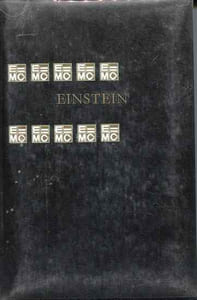
Référence : 16775EINSTEIN Albert
Collectif : Louis de Broglie, Louis Armand, Hilaire Cuny, Théo Kahan, François Le Lionnais, Jacques Madaule, Roger Nataf, François Russo, S. J., Pierre-Henri Simon.,Paris, Hachette Collection 'Génies et Réalités' 1966, 295 pp., 1 vol. in 8 relié

18,00 €
Livres
Référence : R150214942EINSTEIN ALBERT.
COMMENT JE VOIS LE MONDEFLAMMARION. 2009. In-8. Broché. Bon état, Couv. convenable, Dos satisfaisant, Intérieur frais. 243 pages. . . . Classification Dewey : 925-Savants, explorateurs
Classification Dewey : 925-Savants, explorateurs

Sablons, France
24,90 €
Livres
Référence : 73034Einstein ( Albert )
Comment je vois le mondeFlammarion 2005, format poche n° 183; collection Champs - très bon état
Romans sur Isère, France
6,00 €
Livres
Référence : 33600EINSTEIN Albert
COMMENT JE VOIS LE MONDEParis Le Club Français du Livre 1969 in 8 (21,5x14) 1 volume reliure toilée beige de l'éditeur, 241 pages [1]. Traduit de l'allemand par Maurice Solovine. Edition numérotée hors-commerce. Bel exemplaire ( Photographies sur demande / We can send pictures of this book on simple request )
Très bon Couverture rigide Ed. numérotée
Saint André de Sangonis, France
15,00 €
Livres
Référence : SLIVCN-9782080483782Einstein, Albert
Comment je vois le mondeFlammarion (6/2025)
LIVRE A L’ETAT DE NEUF. EXPEDIE SOUS 3 JOURS OUVRES. NUMERO DE SUIVI COMMUNIQUE AVANT ENVOI, EMBALLAGE RENFORCE. EAN:9782080483782

Genève, Suisse
29,89 €
Livres
Référence : 48656EINSTEIN Albert
COMMENT JE VOIS LE MONDEParis, FLAMMARION, 1958; in-8 broché, 218 pp. BON ETAT
Nombreux titres disponibles en Philosophie.

10,00 €
Thèmes voisins
- Arago François
- Barnett Lincoln
- Bernoulli
- Bertin Michel
- Besson Jacques
- Boll Marcel
- Bombes atomiques
- Boutaric Augustin
- Bramand P
- Branly Édouard
- Broglie Louis de
- Brunhes Bernard
- Caselli Giovanni
- Champ magnétique
- Chevriere C
- Colardeau E.
- Collignon Édouard
- Dauvillier Alexandre
- Dulac Y
- Dupuy Gaston
- Duval Paul
- Evans Oliver
- Fabry Charles
- Foucault Léon
- Gamow George
- Gapaillard Jacques
- Gay-Lussac
- Gribbin John
- Grove William Robert
- Guye Charles-Eugène
- Houllevigue Louis
- Huyghens Christiaan
- Jeans Sir James
- Joliot-Curie Frédéric
- Joliot-Curie Irène
- Jörgensen Holger
- Jouguet Émile
- Kammerer Victor
- Kapitza
- Labarthe André
- Lavoisier Antoine
- Lemoine Jules
- Machine Vapeur
- Mariotte Edme
- Maxwell James Clerk
- Mecanique
- Meteorologie
- Millikan Robert Andrews
- Moteurs
- Neige
- Newton
- Nucleaire
- Ondes
- Papin Denis
- Piron Constantin
- Piston
- Prigogine Ilya
- Puiseux Louis
- Sandori Paul
- Secheresse
- Sigaud de la Fond
- Thibaud Jean
- Thorne Kip S.
- Turbine
- Typhon
- Vent
- Ventilation
- Vitesse